
How Customer Requirements Evolve Into Process Controls
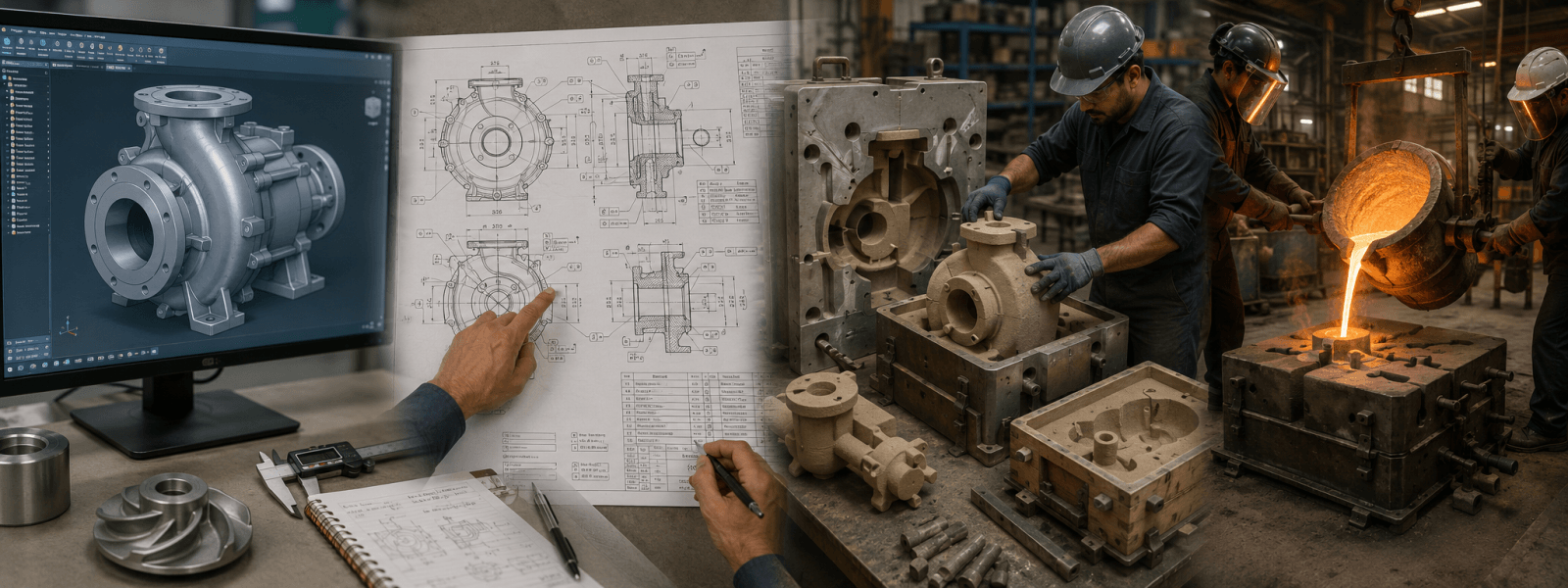
Customer requirements do not become casting quality by accident.
They have to be translated.
A drawing, model, purchase order, material specification, or inspection note may describe what the buyer wants. It does not always describe what the foundry must control to make that requirement real.
That translation is one of the most important steps in the casting process.
By the time metal enters the mold, many quality decisions have already been made. The alloy has been selected. The casting process has been chosen. Tooling assumptions have been made. Gating, risering, inspection, machining stock, repair limits, test requirements, and documentation may already be built into the job.
If those requirements are clear early, they can become useful process controls.
If they are unclear, incomplete, unrealistic, or discovered too late, they can become scrap, rework, delay, and frustration.
The Quote Is the First Control Point
For many jobs, the first major process control is not on the foundry floor. It happens during quote review.
This is where the foundry decides whether the part, alloy, process, inspection level, delivery requirement, and customer expectation fit together. A casting may look simple on a drawing but still carry real risk. Thin sections, heavy section changes, isolated hot spots, tight tolerances, pressure boundaries, deep cores, machined sealing surfaces, or severe service conditions can all change how the job should be planned.
A good quote does more than assign a price.
It confirms the assumptions that will control the job.
What alloy is required? What service environment will the casting see? Are there pressure or leak-tightness requirements? What inspection standard applies? Are radiography, liquid penetrant inspection, mechanical testing, chemistry certification, or dimensional reports required? Are weld repairs allowed? Are the tolerances realistic for the casting process? Are there critical machined surfaces where internal defects may be exposed later?
These questions are not obstacles to getting work. They help foundries avoid jobs that are technically different from what the quote assumed.
Requirements Must Become Foundry Actions
Most customer requirements arrive as words on paper. The foundry has to convert them into controlled actions.
A material callout becomes charge control, chemistry verification, melt practice, heat treatment planning, and certification.
A mechanical property requirement becomes alloy selection, section-size awareness, test coupon planning, heat treatment control, and documentation.
A pressure requirement becomes feeding discipline, soundness control, repair planning, surface condition review, and pressure testing.
A radiographic requirement becomes gating and risering scrutiny, shrinkage control, melt cleanliness, and agreement on acceptance level.
A tight tolerance becomes pattern allowance, mold control, process repeatability, machining stock review, and dimensional inspection.
A seawater or corrosive service requirement becomes alloy discipline, microstructure awareness, repair control, heat treatment attention, and final verification.
In other words, the requirement has to become something that can be done, measured, checked, and repeated. If it does not become a process control, it remains an expectation waiting to become a dispute.
Alloy Names Are Not Enough
This point matters across non-ferrous foundries, and it is especially important for demanding alloy families such as nickel aluminum bronze and copper-nickel.
A customer may specify the alloy correctly, but alloy name alone does not produce performance. The final casting still depends on melt cleanliness, turbulence control, feeding, solidification, heat treatment, repair procedure, and inspection planning.
Nickel aluminum bronze is a good example. It is valued for strength, corrosion resistance, wear behavior, and seawater performance. But those advantages depend on disciplined foundry practice. Aluminum helps make the alloy useful in service, but it also increases the need to control oxidation, dross, turbulence, and entrained films during melting and pouring.
Copper-nickel alloys bring their own discipline. They may be selected for seawater service and corrosion resistance, but the casting still has to be sound, clean, properly fed, and inspected to the correct requirement.
A casting can meet chemistry and still fail the real customer need if the process produces shrinkage, porosity, inclusions, surface defects, dimensional problems, or repair-related concerns.
The specification matters.
The process determines whether the specification becomes a reliable casting.
Inspection Should Confirm Quality
Inspection is necessary, but inspection does not create quality by itself.
Inspection tells us what the process produced. It may reveal shrinkage, gas porosity, inclusions, cracks, surface indications, dimensional problems, or documentation gaps. But by the time those problems appear, the casting has already consumed material, labor, equipment time, and schedule.
That is why inspection requirements should influence planning before production begins.
If radiography is required, soundness should be considered during gating and risering review.
If pressure testing is required, leak-tightness should influence feeding, repair control, surface condition, and final inspection.
If heavy machining is required, the foundry should consider where internal defects are most likely to be exposed.
If documentation is required, traceability should be built into the job from the beginning.
The best inspection results usually come from processes designed to meet the requirement.
Better Requirements Create Better Controls
Good casting outcomes depend on clear communication between the customer, designer, buyer, foundry, machinist, inspector, and user. When requirements are unclear, the foundry should ask questions. When the foundry sees risk, the customer should be willing to discuss it early.
This is not about blame. It is about preventing avoidable problems.
A casting is not just a shape. It is a material, a process, a specification, an inspection plan, a service condition, and a set of decisions that must work together.
That is one of the practical lessons behind the NFFS Technical Services Office and the R3 Technical Program. Rejects are often discovered at the end of the process, but many begin much earlier: during quote review, drawing review, specification review, tooling decisions, inspection planning, or the first assumptions made about how the job should run.
Customer requirements should not sit on the purchase order until final inspection.
They should evolve into process controls before the pour.
That is how requirements become quality.
And that is how foundries reduce surprises before they become rejects.