
Customer First, Last, Always
The Difference Is in the Details
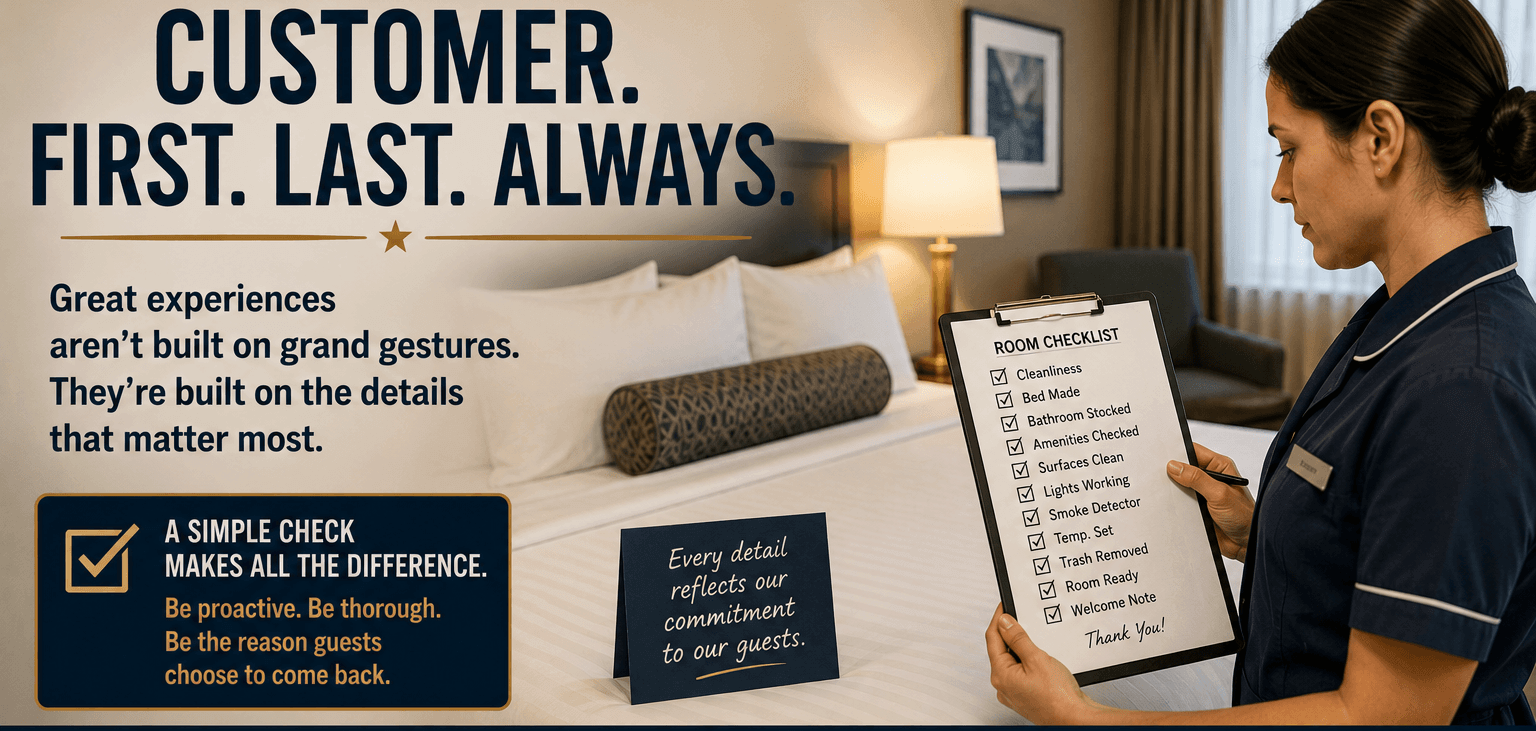
Over the past few days, I traveled through Wisconsin and stayed at two different hotels, a DoubleTree in Racine and a Residence Inn in Milwaukee. Different brands. Different ownership. Different locations.
 The experience, unfortunately, was remarkably similar.
The issue wasn't that the hotels were old. It wasn't that they were busy. It wasn't that something broke. Those things happen. What stood out was something much more concerning: a complete breakdown in the small details that define customer service.
Like many hotels today, both properties have replaced individual bottles of shampoo and body wash with wall-mounted dispensers. From an environmental standpoint, that makes sense. Less waste. Less plastic.
The problem was that when I stepped into the shower at each hotel, there was no body wash.
Nothing.
After a long day of travel, there are few things more frustrating than discovering you have no soap while standing in the shower. Nobody needed new technology, additional training, or a large capital investment to prevent the problem. Someone simply needed to verify that the dispenser was filled before the room was turned over to the next guest.
 The Residence Inn provided another lesson. Outside our room sat a storage container filled with water and removed ceiling tiles, clearly indicating a leak or maintenance issue. There was no communication about what had happened or when it would be resolved. When I mentioned it to the front desk, an employee assured me someone would take care of it. Yet the next day it was still there.
As I walked through the hotel, more signs appeared. Piles of garbage outside guest rooms. Dirty hallways. A broken washing machine sitting in a hallway with a pipe lying next to it. None of these issues alone would have ruined the stay. Together, however, they told a story, a story that suggested nobody was paying attention, standards had slipped, and the customer experience was no longer the priority.
The reality is that hotel room rates continue to increase. Customers understand inflation and rising labor costs. What customers struggle to accept is paying more while receiving less. More importantly, customers have choices. In Milwaukee alone, there were dozens of hotels within a few miles. Why should I return when there are so many alternatives available?
As I reflected on those experiences, I couldn't help but think about one of the most important lessons we teach through the Talent Pipeline Program and particularly during the Leadership Retention Training workshop.
The issue wasn't that an employee made a mistake. People make mistakes every day. The issue was that the organization failed to catch the mistake before it affected the customer.
That distinction is critical.
One of the core principles discussed during Leadership Retention Training is that individuals are not expected to be perfect. Human beings are imperfect. Employees get distracted. Supervisors become overwhelmed. Managers face competing priorities.
What customers expect, however, is that the team performs perfectly.
In the foundry industry, customers provide specifications that must be met. They are not asking for something that is close enough. They expect the chemistry to be correct, the dimensions to be accurate, the mechanical properties to meet requirements, and the casting to perform exactly as intended. In many applications, that casting becomes part of a larger system where failure is simply not an option.
Customers understand that people are not perfect. What they expect is a system that prevents individual mistakes from becoming customer problems. That is why leadership matters.
The empty body wash dispensers at those hotels were not a people problem. They were a system problem. Someone probably intended to refill them. Someone may have assumed another employee had already completed the task. Whatever happened, the customer experienced the failure because the system failed.
The same principle applies in a foundry. A missed inspection, delayed maintenance repair, unchecked process variable, or overlooked customer concern may seem minor in the moment, but each represents an opportunity for a customer problem to occur. More importantly, each sends a message about the standards an organization is willing to accept.
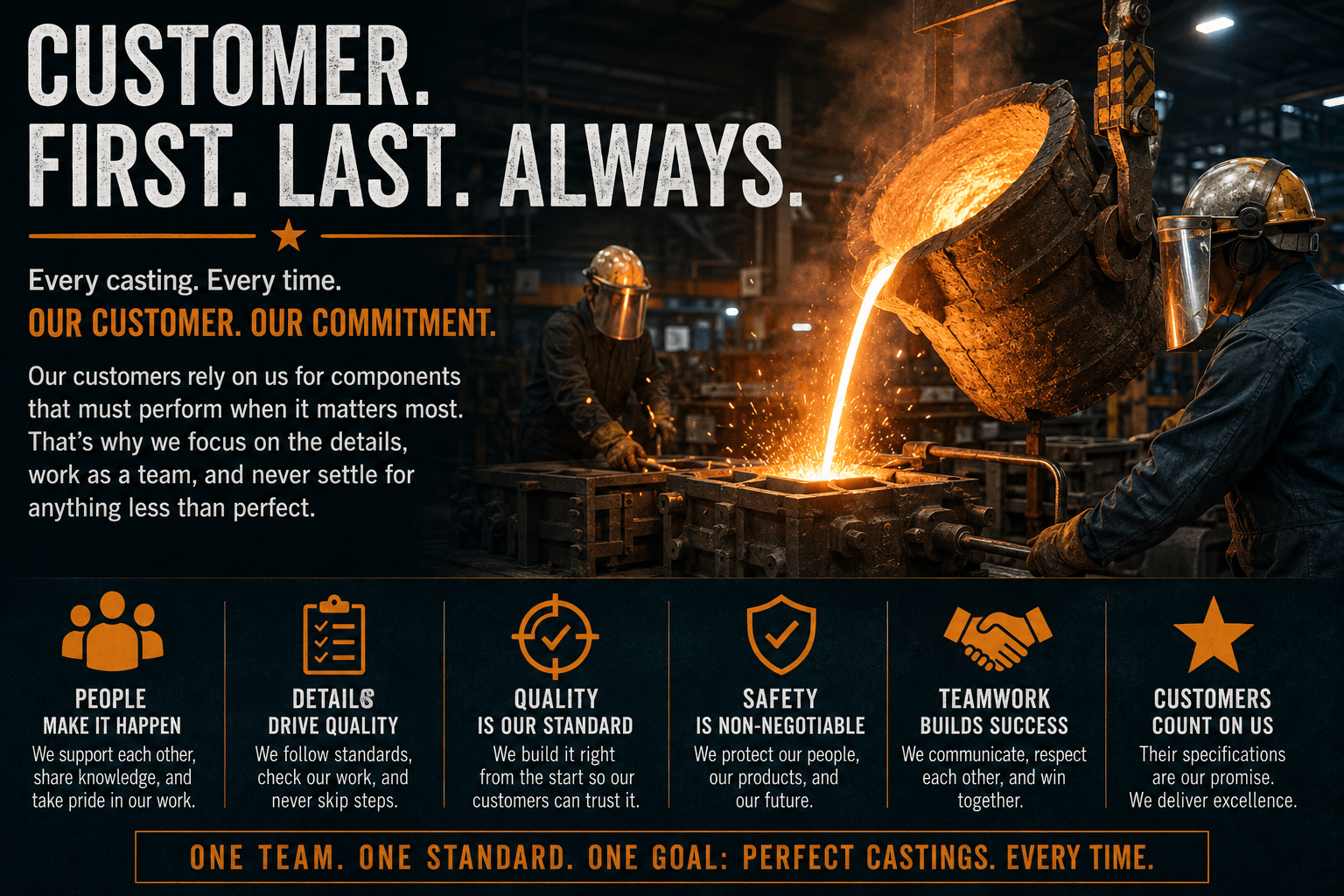 During Leadership Retention Training, supervisors are challenged to think differently about perfection. The objective is not to create perfect employees. The objective is to create leaders who believe perfect execution is possible when the entire team works together around a shared standard. Leaders who accept recurring problems as "just the way things are" eventually create organizations that operate with that same mindset. Leaders who believe every problem can be improved create teams that actively look for solutions.
Foundry leaders must believe that perfect is possible because that is exactly what the customer is asking for. Every casting specification represents a promise. The customer is trusting your team to deliver a product that meets every requirement. They are not paying for effort. They are paying for results. While perfection may be unrealistic for any individual employee, it must remain the expectation of the organization as a whole.
That is why the Talent Pipeline Program places such a strong emphasis on leadership development. Retaining employees is not simply about reducing turnover. It is about creating a culture where people understand the importance of their role, take pride in their work, and recognize how their individual responsibilities contribute to the success of the entire organization. When leaders establish high standards, employees are more likely to embrace them. When leaders model accountability, employees are more likely to demonstrate it. When leaders believe perfect execution is possible, teams are more likely to pursue it.
The lesson from both hospitality and manufacturing is remarkably similar. Customers rarely leave because of one catastrophic failure. More often, they leave because of a series of small disappointments that signal a lack of attention, accountability, and care.
Organizations that consistently put the customer first understand that excellence is not achieved through grand gestures. It is achieved through hundreds of small actions performed correctly every day by people who understand why their work matters and leaders who refuse to accept that "good enough" is good enough.
Customer. First. Last. Always.
It is not a slogan.
It is a standard.
And it is a standard that every employee, supervisor, manager, and executive must embrace if they expect customers to keep coming back.