
New NIST Funding Could Help Small and Midsized Foundries Modernize and Compete
New NIST Funding Could Expand Advanced Manufacturing Support for Foundries
Nearly $46.5 million in potential funding could bring more technology, workforce and operational support to small and midsized manufacturers.
For many small and mid-sized foundries, the challenge is not recognizing the potential of automation, robotics or artificial intelligence. It is finding the time, expertise and resources to put those technologies to work on the foundry floor.
A newly announced federal funding opportunity could help close that gap.
The National Institute of Standards and Technology (NIST) has announced nearly $46.5 million in potential funding to establish Manufacturing Extension Partnership (MEP) centers in 14 states and territories. The initiative is designed to help small and midsized U.S. manufacturers adopt advanced technologies, increase production capabilities, strengthen supply chains and build a more skilled workforce.
At a Glance
$46.5 million in potential funding • 14 states and territories • Applications due August 21, 2026
Where New MEP Centers Could Be Established
Missouri • Montana • Ohio • Pennsylvania • Puerto Rico • Utah • Vermont
What Could This Mean for Non-Ferrous Foundries?
This announcement is not a direct grant opportunity for individual foundries. Instead, NIST will fund organizations selected to operate MEP centers in these locations. Those centers will then work directly with small and midsized manufacturers (including eligible foundries) to help them modernize, solve operational challenges and remain globally competitive.
For foundries, expanded MEP resources could mean greater access to affordable, hands-on support in areas such as:
- Robotics and process automation
- Artificial intelligence and data utilization
- Production efficiency and capacity improvement
- Additive manufacturing and advanced materials
- Cybersecurity and risk management
- Supply-chain integration and resiliency
- Workforce recruitment, training and development
- Quality systems and continuous improvement
- Technology assessment and implementation planning
The emphasis on practical technology adoption is especially relevant for foundries. Advanced manufacturing does not have to mean rebuilding an entire facility or making an enormous capital investment. It can begin with targeted improvements: automating a repetitive task, using production data to reduce scrap, improving scheduling, strengthening process control or introducing technology that helps employees work more safely and effectively.
Why This Matters Now
Small and midsized manufacturers represent approximately 98% of the U.S. manufacturing base, yet they often face the greatest barriers to adopting new technology. Foundries must evaluate potential investments while managing tight margins, workforce shortages, demanding customers and daily production pressures.
The MEP National Network is intended to help manufacturers navigate those decisions. It currently includes nearly 1,400 manufacturing advisers and experts working through more than 450 service locations nationwide.
With this new funding, NIST is placing renewed emphasis on moving advanced technology beyond demonstrations and into real manufacturing environments where it can increase productivity, expand domestic capacity and strengthen American supply chains.
For foundries, that could mean more local expertise, stronger regional partnerships and additional help turning promising technology into measurable operational results.
What Foundries Should Do Next
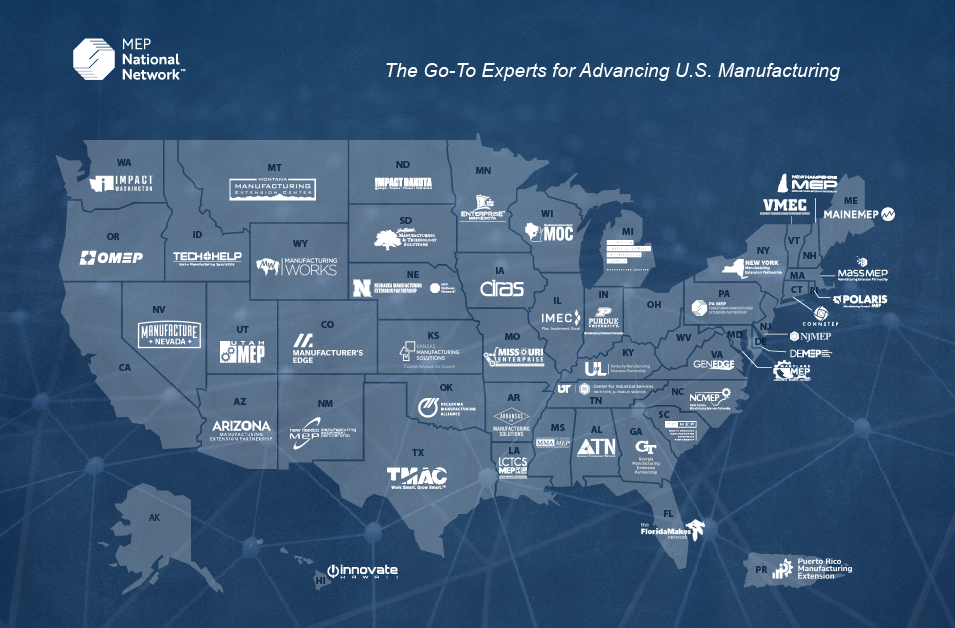
NIST MEP National Network
Foundries located in one of the 14 covered states or territories should monitor developments with their current or future state MEP center. You can find your local center using the NIST MEP Center Map, review the MEP Center Quick List or call (800) MEP-4MFG.
Once the awards are finalized, companies should ask what new assessments, technical services, training programs or cost-sharing opportunities may become available.
Start by identifying your highest-priority challenges:
- Where are labor shortages limiting production?
- Which processes generate the most scrap, downtime or rework?
- What information is being collected but not fully used?
- Which repetitive or hazardous tasks may be candidates for automation?
- What capabilities will customers expect from the foundry in the next three to five years?
Having those priorities defined will allow foundries to act quickly when new services and resources become available.
Organizations seeking to operate the 14 MEP centers must submit their applications to NIST by August 21, 2026. NFFS will continue monitoring the program and sharing relevant developments with members as the competition progresses.