
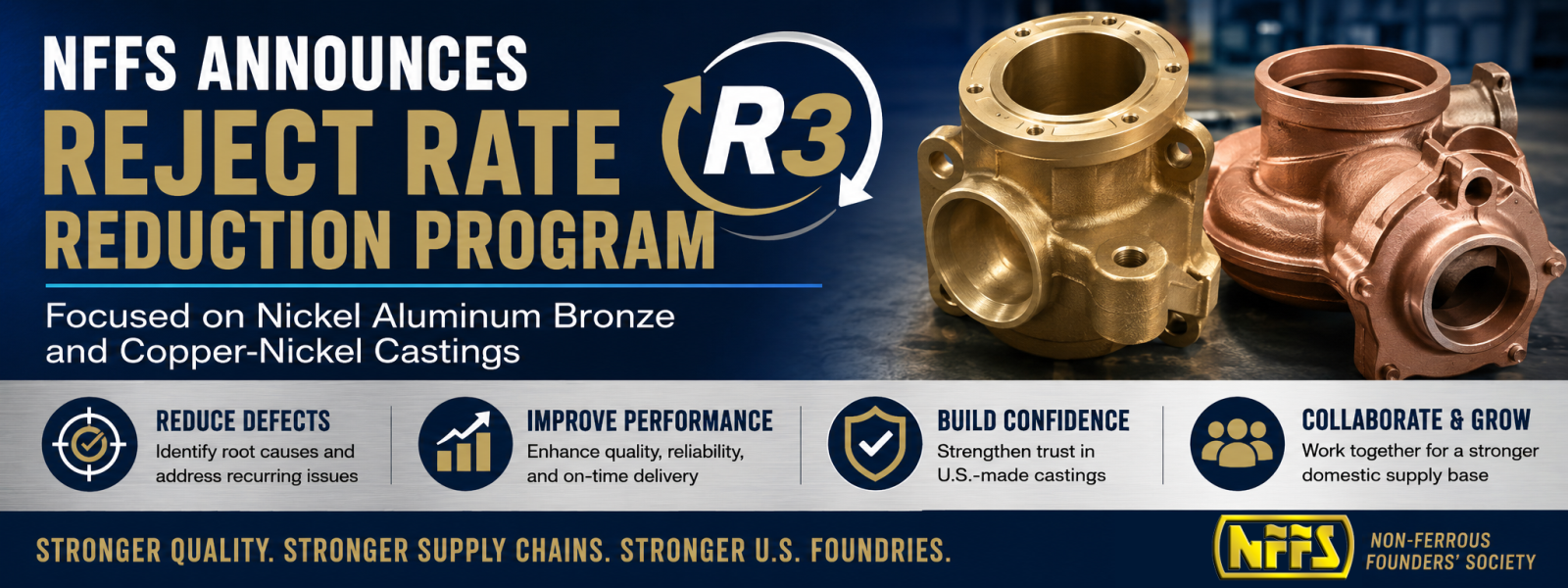
The Non-Ferrous Founders’ Society has launched the Reject Rate Reduction Program, or R3, to help U.S. non-ferrous foundries improve casting quality, reduce avoidable rejects, and strengthen confidence in domestic supply.
The program will begin with a focused effort on Nickel Aluminum Bronze (NAB) and Copper-Nickel (CuNi) castings. These alloys are essential to naval, marine, defense, industrial, and infrastructure applications. They are also difficult materials to produce consistently, especially when complex geometry, demanding inspection requirements, secondary processing, and qualification expectations are involved.
R3 is built around a simple idea: the people closest to the work need to help define the problems, and the industry needs a practical mechanism for solving them together.
This is not an audit. It is not a compliance review. It is not a fault-finding exercise. R3 is intended to be a technical resource for foundries and suppliers working through real production challenges.
Why This Program Matters
Every foundry understands the frustration of a recurring quality issue that refuses to stay solved. A casting may meet the purchase requirements when it leaves the foundry, only to become a problem later during machining, welding, pressure testing, inspection, qualification, or customer processing. In many cases, the information that comes back to the foundry is incomplete, delayed, or difficult to translate into a meaningful corrective action.
R3 is intended to help close that loop.
NFFS will work with foundries, suppliers, customers, technical experts, and other stakeholders to identify common sources of rejection, delivery delay, inspection difficulty, and qualification risk. The goal is to separate isolated problems from recurring industry patterns, then turn those findings into practical guidance that foundries can actually use.
If the program is successful, it will help the industry reduce scrap and rework, improve delivery performance, strengthen customer confidence, and create a clearer path for more non-ferrous casting work to remain in the domestic supply base.
How R3 Will Work
The first phase of the program will focus on engagement and discovery. NFFS will work to identify foundries, suppliers, OEMs, shipyards, material suppliers, and other stakeholders connected to high-priority naval component production. Because the program does not begin with a complete list of problem parts or suppliers, this early work is essential. The industry itself will help define where the real problems are.
From there, NFFS will begin collecting and reviewing available information related to quality, delivery, reject rates, recurring defects, qualification barriers, root cause analysis, and production practices. Where specific part or NSN-level data is available, it will be reviewed. Where it is not available, the program will focus on part families, alloy/process categories, supplier pathways, and recurring defect mechanisms.
R3 will also include a benchmarking component. NFFS will compare U.S. practices with relevant practices from the United Kingdom and Australia, particularly around NAB and CuNi casting production, defect classification, reporting terminology, inspection expectations, and process control. This comparison is intended to identify practical improvement opportunities, not to create artificial rankings between companies or countries.
The program will then move into targeted technical assistance. Participating foundries and suppliers may receive support related to root cause analysis, Technical Data Package review, tooling and gating evaluation, solidification modeling, process validation, inspection review, NDT considerations, qualification support, or other practical process improvement needs.
Where recommendations are implemented, NFFS will help document available before-and-after results so the program can show whether the work produced measurable improvement.
Protecting Company Information
Foundry data is sensitive. R3 depends on trust, and NFFS understands that companies will not participate meaningfully if they believe their internal quality information could be exposed or misused.
Company-specific information will be handled carefully. Program-level reporting, benchmarking, public guidance, and industry presentations will use anonymized, aggregated, or otherwise protected information wherever appropriate. The purpose of this program is not to rank foundries or assign blame. The purpose is to understand shared technical barriers and help the industry reduce them.
What Foundries Can Gain
For participating foundries, R3 offers a chance to help shape the technical conversation around NAB, CuNi, and related alloy systems.
The program is intended to provide practical value, including clearer insight into recurring rejection mechanisms, better communication around customer-side quality concerns, access to benchmarking and best-practice development, support for root cause analysis, and a stronger technical voice in conversations involving customers and government stakeholders.
Just as importantly, participation helps ensure that future recommendations are informed by people who actually make these castings. Foundries should not have technical expectations written around them without their input.
Industry Participation Is Essential
R3 cannot succeed as a desk study. It needs the experience of foundry managers, operators, metallurgists, engineers, quality personnel, technical leaders, suppliers, customers, and others who understand the realities of producing these alloys.
NFFS is forming an R3 Steering Committee to help guide the program. The committee will help frame the technical problem set, identify priority issues, review proposed approaches, and keep the work grounded in real foundry practice.
NFFS especially encourages participation from companies and individuals with experience in:
- Nickel Aluminum Bronze and Copper-Nickel castings
- Copper-base alloy melting and casting practice
- Naval, marine, defense, or infrastructure component production
- Foundry quality systems and root cause analysis
- Inspection, NDT, qualification, and customer technical requirements
- Tooling, gating, risering, solidification, process control, and secondary processing
Get Involved
Companies and individuals interested in participating in the R3 Program or joining the R3 Steering Committee should contact:
Ian Wiese
Director of Technical Services
Non-Ferrous Founders’ Society
ian@nffs.org
R3 is an opportunity for the non-ferrous foundry industry to work together, define its own technical needs, and strengthen the domestic casting supply base.
Stronger quality. Stronger supply chains. Stronger U.S. foundries.