
AMC Acquisition Codes: What Are They and Why Are They Important
 Companies in the casting, forging, and machining sectors have long supplied critical components to the U.S. Government and Department of Defense (DoD). From turbine housing and forged shafts to precision-machined aerospace components, these industries are foundational to national defense, transportation, energy systems, and industrial infrastructure.
However, many capable manufacturers overlook significant government contracting opportunities because they are unfamiliar with one important acquisition tool: AMC and AMSC codes.
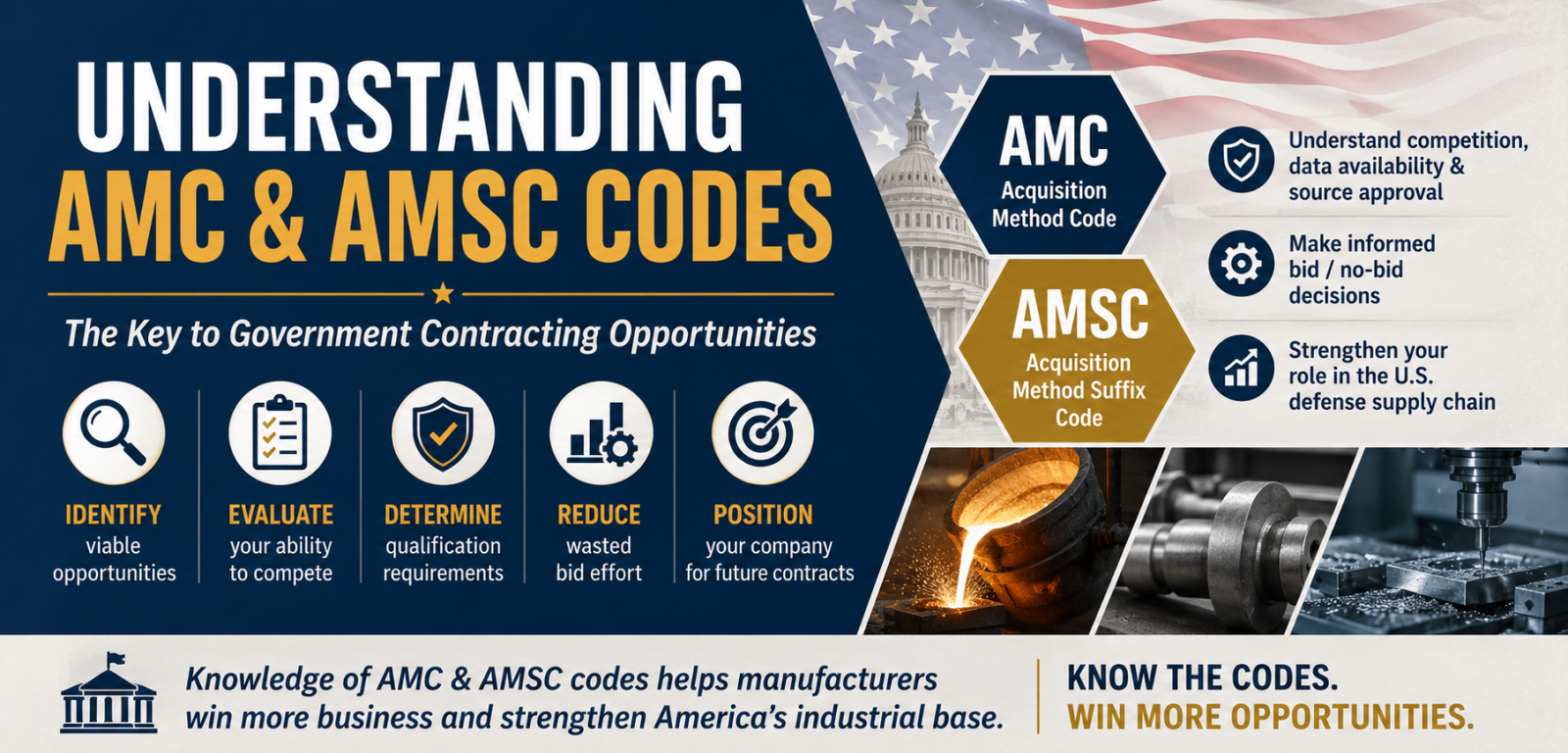
These codes are used extensively in federal procurement to communicate the level of competition, technical data availability, and source approval requirements associated with a solicitation. Understanding them can dramatically improve a company’s ability to:
- Identify viable opportunities
- Evaluate whether they can compete
- Determine qualification requirements
- Reduce wasted bid effort
- Strategically position themselves for future contracts
For companies seeking to enter or expand within the government marketplace, AMC and AMSC codes are essential business intelligence tools.
What Are AMC and AMSC Codes?
AMC — Acquisition Method Code
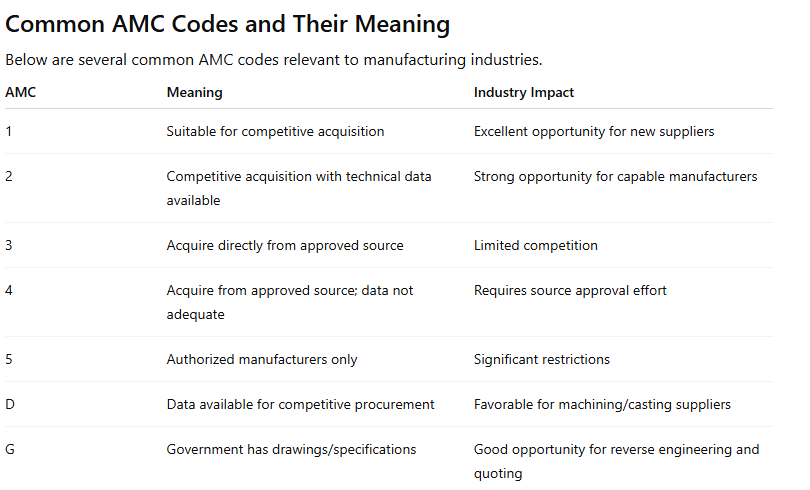
The Acquisition Method Code (AMC) identifies the government’s strategy for acquiring a part or item. It tells contractors:
- Whether the item is competitive or restricted
- Whether technical data is available
- Whether the item must come from an approved source
- Whether qualification or testing is required
AMC codes are commonly used by:
- Defense Logistics Agency (DLA)
- Department of Defense procurement agencies
- Military supply chains
- Prime contractors supporting defense programs
These codes appear in solicitations, procurement histories, and government databases.
AMSC — Acquisition Method Suffix Code
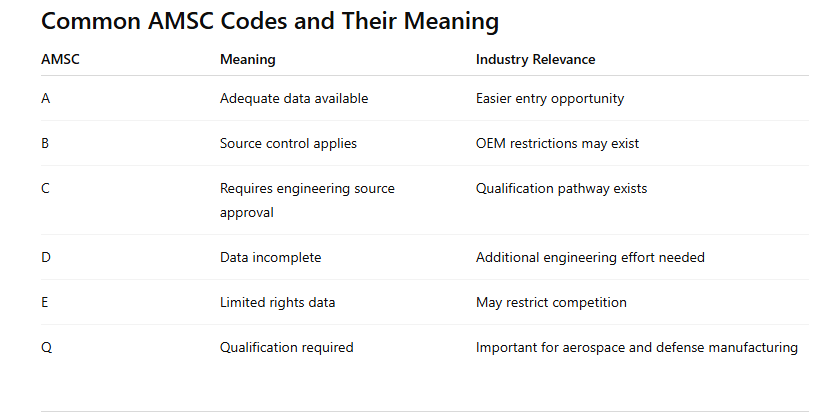
The Acquisition Method Suffix Code (AMSC) provides additional detail that supplements the AMC code.
While the AMC identifies the general acquisition approach, the AMSC explains:
- Why competition may be restricted
- Whether drawings are available
- Whether proprietary data exists
- What barriers may prevent a company from bidding
Together, AMC and AMSC create a more complete picture of a procurement opportunity.
Why AMC and AMSC Codes Matter?
For manufacturers, these codes answer one of the most important questions in government contracting:
“Can we realistically compete for this requirement?”
Without understanding these codes, companies may:
- Spend resources bidding on closed or proprietary items
- Miss opportunities where competition is open
- Failure to recognize qualification requirements
- Mis-judge technical barriers
- Ignore strategic long-term opportunities
With proper understanding, companies can quickly determine:
- Whether they are eligible
- Whether they can become eligible
- Whether engineering investment is worthwhile
- Whether teaming or source approval is needed
Importance to the Casting Industry
1. Identifying Opportunities To WIN
Many government solicitations involve:
- Raw castings
- Forged components
- Precision-machined parts
- Repair and replacement hardware
- Aerospace structural items
- Naval propulsion components
- Ground vehicle parts
AMC/AMSC codes help determine whether these items are:
- Open for competitive manufacture
- Controlled by proprietary data
- Restricted to approved sources
- Suitable for reverse engineering
- Candidates for alternate manufacturing
This is particularly important for shops with strong manufacturing capability but limited government contracting experience.
2. Evaluating Technical Data Availability
A machining or forging company may have excellent production capability but still be unable to bid if technical drawings are unavailable.
AMC/AMSC codes quickly indicate:
- Whether the government owns the technical data
- Whether drawings can be accessed
- Whether data rights are restricted
- Whether qualification packages exist
This prevents wasted quoting effort.
How Manufacturers Should Use AMC/AMSC Codes
Screen Opportunities Quickly
Before investing engineering and estimating resources, review:
- AMC
- AMSC
- NSN history
- Technical package availability
This helps determine whether the opportunity is:
- Open competition
- Restricted competition
- Sole source
- Source-controlled
- Qualification-based
Example
A precision machine shop sees a Navy solicitation for a shaft assembly.
- AMC = 2
- AMSC = A
This suggests:
- Competition is allowed
- Technical data is available
- The company can likely bid immediately
This becomes a high-priority opportunity.
Benefits to the Industrial Base
The broader manufacturing industrial base benefits because AMC/AMSC systems:
- Improve transparency
- Clarify procurement pathways
- Enable supplier development
- Encourage domestic manufacturing
- Expand defense supply chain resilience
For the U.S. Government, strengthening domestic casting, forging, and machining capability is increasingly viewed as a national security priority.
Best Practices for Industry
1. Build Internal AMC/AMSC Knowledge
Train:
- Estimators
- Program managers
- Business development personnel
- Engineers
- To interpret acquisition codes correctly.
2. Use Codes as Bid/No-Bid Filters
Avoid wasting resources on:
- Proprietary items
- Closed-source procurements
- Unobtainable approvals
- Focus on realistic opportunities
Conclusion
AMC and AMSC codes are far more than administrative procurement labels. They are strategic tools that help both government agencies and manufacturers evaluate the feasibility, competitiveness, and technical accessibility of procurement opportunities.
For the casting, forging, and machining industries, understanding these codes can significantly improve success in the government marketplace by helping companies:
- Identify realistic opportunities
- Align solicitations with manufacturing capability
- Reduce wasted bidding effort
- Plan qualification investments
- Build long-term defense business
As the government continues emphasizing domestic manufacturing resilience and supply chain security, manufacturers that understand and leverage AMC/AMSC codes will be better positioned to compete, qualify, and grow within the federal contracting environment.