
2026 Innovation Summit Wrap-Up
2026 Innovation Summit Wrap-Up
Technology is changing manufacturing at an extraordinary pace. Artificial intelligence, machine learning, robotics, computer vision, connected equipment, and advanced data platforms are creating capabilities that would have seemed unrealistic only a few years ago.
For many foundries, however, the challenge is no longer understanding that these technologies exist. The challenge is determining what they can actually do, where they fit within existing operations, and how they can be implemented without disrupting the people and processes that keep the foundry running.
That was the central focus of the 2026 NFFS Innovation Summit, held July 22–23 at Gecko Robotics in Pittsburgh. Built around the theme of “Practical Solutions for Everyday Foundry Operations,” the summit brought together foundry leaders, technical professionals, technology providers, and industry partners to examine how innovation can produce measurable improvements without requiring a complete transformation of the business. (Non-Ferrous Founders Society)
The message throughout the event was consistent: innovation does not have to begin with a multimillion-dollar automation project. It can begin with a recurring production problem, information that is already being collected, and a willingness to examine the process more clearly.
Making Technology Visible
Gecko Robotics provided an ideal setting for that conversation. Through facility tours and technical discussions, attendees received a hands-on view of how robotics, sensors, artificial intelligence, machine learning, and advanced inspection technologies can be combined to gather information from difficult industrial environments.
The value of seeing these systems in operation cannot be overstated. Technologies that appear abstract in a presentation become much easier to understand when attendees can see how a robotic platform collects information, how that information is organized, and how it can support a better maintenance, inspection, or operating decision.
The tours also reinforced an important distinction. Collecting more information is not automatically the same as improving an operation. The value comes from converting that information into something that a supervisor, operator, maintenance technician, engineer, or manager can use.
A foundry does not benefit simply because a sensor generates another measurement. It benefits when that measurement helps someone recognize a developing problem, compare performance, prevent downtime, reduce scrap, or make a more informed decision.
The Visibility Problem
That distinction was also central to the session titled “You Don’t Have a Data Problem. You Have a Visibility Problem,” presented by Ian Wiese of NFFS and Tim Johnson of MetalCloud.
Most foundries already generate enormous amounts of information. It may exist in furnace logs, inspection reports, scrap records, maintenance notes, production schedules, operator worksheets, laboratory results, photographs, emails, spreadsheets, or conversations between experienced employees.
The difficulty is that much of this information remains separated by department, shift, system, or individual.
A quality manager may recognize a recurring defect pattern. An operator may know that a particular condition usually appears before a process begins to drift. Maintenance may understand which piece of equipment is becoming unreliable. Production control may see that a recurring delay begins at the same point in the routing.
Each person may possess part of the answer, but the organization may not have a reliable way to bring those observations together.
This is why visibility matters. The first opportunity is often not to collect more data, but to make existing information easier to see, compare, and use.
MetalCloud provided one example of how that can be accomplished. The platform is designed specifically for foundries and uses artificial intelligence to create greater visibility across machines, operators, material movement, quality activity, and production execution. (MetalCloud)
Computer vision creates another important opportunity. A system can learn from a foundry’s own images, cameras, examples, and internal classifications. Over time, it can help preserve patterns that experienced employees recognize visually but may struggle to document in a conventional procedure.
This does not replace the experienced foundry professional. It creates a mechanism through which that person’s knowledge can be captured, applied more consistently, and shared with the next generation of employees.
Learning From Practical Implementation
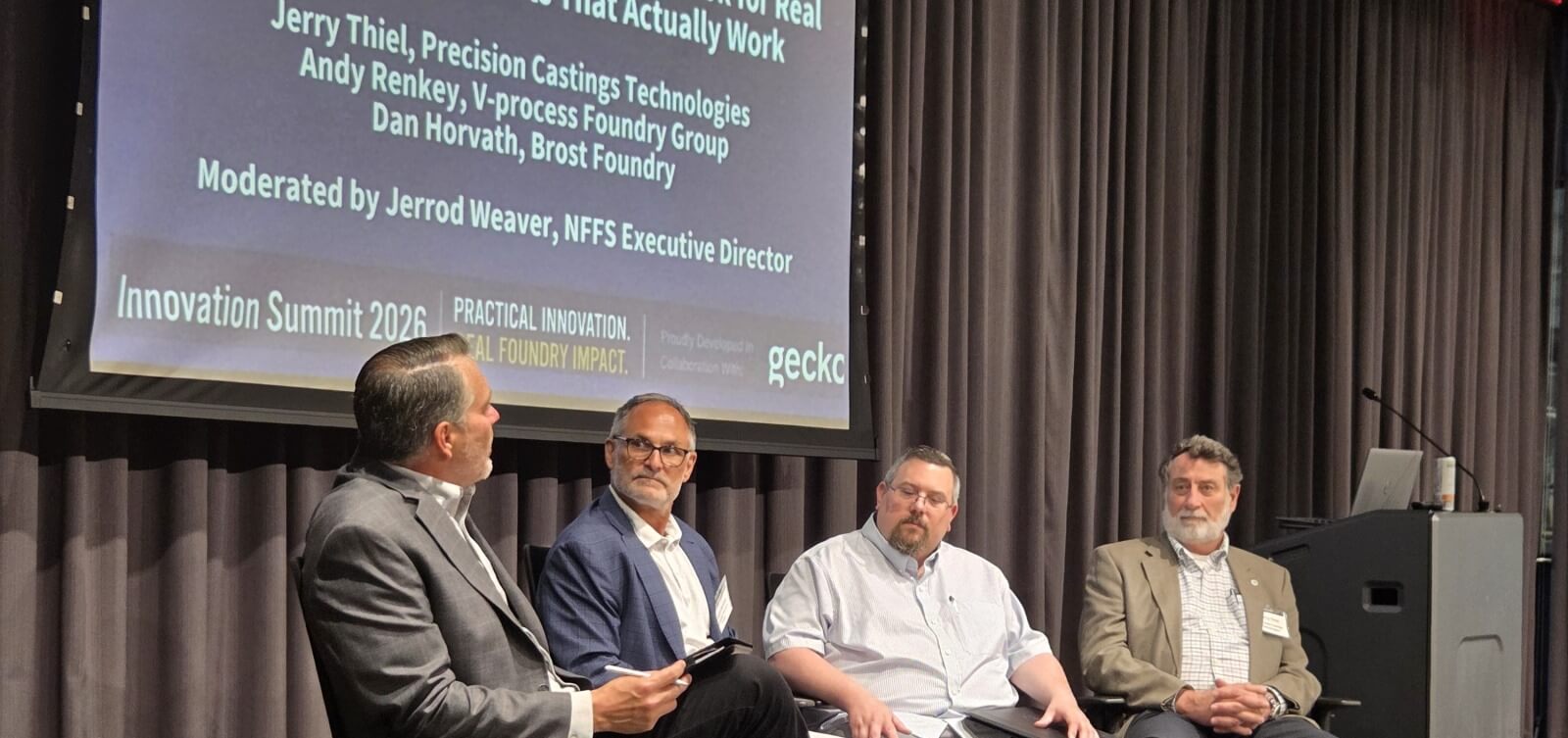
The summit also included a foundry leadership discussion moderated by Jerrod Weaver, NFFS Executive Director. Rather than presenting innovation as a purely technical subject, the conversation focused on what it takes to move an idea into actual foundry use.
That transition is where many technology projects succeed or fail.
A demonstration may be impressive. A software platform may have powerful capabilities. A robotic system may collect highly detailed information. None of those things guarantees that the technology will fit naturally into a specific foundry’s workflow.
Every foundry is different. Equipment, alloys, molding processes, production volumes, inspection requirements, customer expectations, employee responsibilities, and existing software systems vary widely from one operation to another.
The same technology can therefore produce very different results in two different facilities.
Successful implementation begins with understanding the foundry itself. What problem is the company trying to solve? Where is information currently being lost? Who will use the output? What decision will the technology help that person make? How will success be measured?
Without clear answers to those questions, even a capable system can become another isolated tool that employees are expected to maintain without receiving meaningful value in return.
The Importance of the Right Partner
One of the strongest themes to emerge from the summit was the importance of selecting the right technology partner.
Foundries should not be expected to become artificial-intelligence developers, robotics integrators, data scientists, and software architects simply to improve their operations. Their responsibility is to understand their processes, identify their needs, and define what a useful outcome looks like.
A strong technology partner must then be willing to understand the realities of the facility.
That includes the physical environment, the available data, the people performing the work, the reliability of existing records, the condition of the equipment, and the practical limitations of implementation. The best system is not necessarily the one with the longest feature list. It is the one that can be incorporated into the foundry’s operation and used consistently.
Companies such as Gecko Robotics and MetalCloud demonstrated the value of partners that can connect advanced technical capability with real industrial needs. Their role is not simply to sell technology. It is to help the customer determine where that technology can generate a useful, measurable result.
The interface between the technology and the foundry is therefore just as important as the technology itself.
Start With One Problem
Foundries do not need to digitize the entire enterprise before they can benefit from innovation.
A more practical approach is to begin with one clearly defined problem. That might be inconsistent defect reporting, repeated unplanned downtime, poor visibility into production status, variation between shifts, missing process records, or difficulty transferring knowledge from experienced employees.
Establish the current condition. Identify the information already available. Determine what decision needs to improve. Then select a manageable technology application that supports that decision.
A successful first project creates more than an isolated improvement. It helps employees understand what the technology can do, builds confidence in the information being produced, and establishes a foundation for the next application.
This incremental approach also allows the foundry to learn before expanding. Systems can be adjusted, responsibilities clarified, and measures refined while the scope remains manageable.
Scalability should not mean beginning with the largest possible project. It should mean selecting an initial solution that can deliver value now and grow as the organization’s needs and capabilities develop.
Innovation Within Reach
The 2026 Innovation Summit showed that advanced technology does not have to remain mysterious, theoretical, or out of reach for small and medium-sized foundries.
The starting point is often already present inside the operation: existing records, existing cameras, existing process information, and the accumulated knowledge of the people performing the work every day.
The opportunity is to make that knowledge more visible and actionable.
Technology will not define the problem, establish accountability, or create process discipline on its own. It can, however, help foundries recognize patterns sooner, communicate more clearly, preserve critical experience, and make better decisions with greater consistency.
That is a hopeful position for the industry. Foundries do not need to wait for a perfect system or a complete digital transformation. They can begin with the information they already possess, one meaningful problem, and a partner capable of connecting the right technology to the realities of the foundry floor.
The path forward is not innovation for its own sake. It is practical improvement supported by technology—and that path is available to foundries today.