
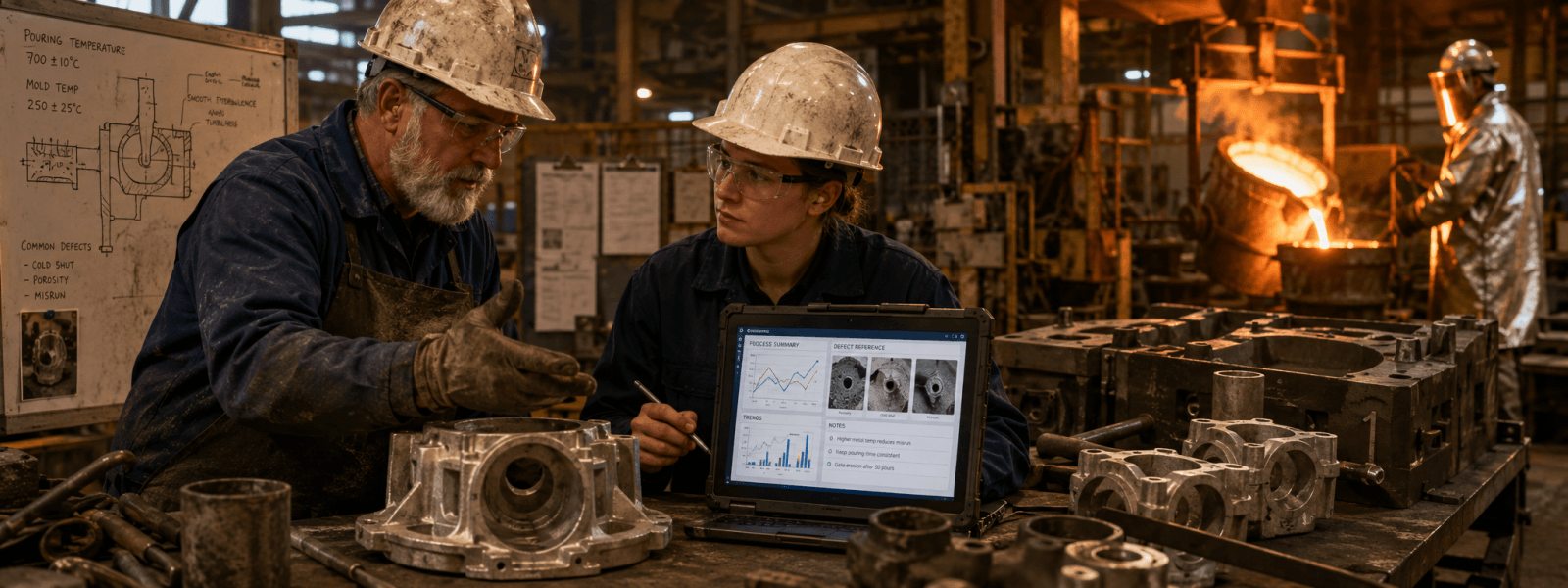
Capturing Foundry Know-How Before It Is Lost
Many foundries operate with more technical knowledge than their formal systems suggest.
That knowledge may not appear in a work instruction, process specification, quality manual, or production database. It lives in the experience of the people who have spent decades learning how a particular furnace behaves, which patterns require extra attention, when a mold “looks wrong,” which defects tend to appear together, and what small adjustment can keep a difficult casting from becoming scrap.
This knowledge is often called tribal knowledge. It is one of the foundry’s most valuable assets—and one of its greatest risks.
A foundry may have employees with 20, 30, or even 40 years of experience who understand the operation at a level that cannot be replaced quickly. They know which practices are written down, which ones are not, and where the real process differs from the official procedure. They understand the exceptions, warning signs, and informal decision rules that allow production to continue when conditions are less than ideal.
When those employees retire, leave, or become unavailable, the foundry does not lose only a person. It can lose years of accumulated problem-solving knowledge.
The danger is that this loss is often invisible until something goes wrong.
A casting that has run successfully for years begins producing intermittent defects. A furnace condition that an experienced operator once recognized early is no longer caught until chemistry or temperature has drifted. A maintenance issue that was routinely anticipated becomes an unexpected shutdown. A quotation is accepted without anyone recognizing that the geometry, alloy, or inspection requirements create unusual risk.
The formal records may show what happened. They may not explain why.
Start With the Decisions People Make
Capturing know-how does not mean asking experienced employees to write a textbook about everything they know. That approach is too broad and usually fails.
A better starting point is to identify the decisions that depend heavily on experience.
What does the operator look for before releasing a heat? What makes the quality manager request another inspection? What conditions cause the molding team to slow down, change a practice, or stop production? What signs tell maintenance that a piece of equipment is beginning to fail? What makes an estimator recognize that a casting will be more difficult than the drawing suggests?
These questions reveal where knowledge is concentrated.
The goal is not simply to document the normal process. Most procedures already describe the normal process. The greater value lies in capturing the judgment used when the process begins to move away from normal.
That includes the warning signs, exceptions, tradeoffs, and corrective actions that experienced personnel apply almost automatically.
Use the Information Already Available
Foundries often assume that knowledge capture requires an expensive new software system. In many cases, the initial work can begin with information that already exists.
Scrap reports, inspection records, furnace logs, production notes, maintenance histories, photographs, customer complaints, corrective actions, laboratory results, and delivery records all contain pieces of the organization’s knowledge.
The problem is that those pieces are often separated.
An experienced employee may be the only person who knows that a particular defect appears more frequently after a specific maintenance condition, during a particular seasonal change, or when several individually acceptable process variables occur at the same time.
Basic analytical tools can help expose these relationships.
Linear regression can help determine whether changes in one variable are associated with changes in another. Trend analysis can show when a process began shifting. Pareto analysis can identify the relatively small number of conditions responsible for a large percentage of losses. Monte Carlo simulation can help evaluate how normal variation across several inputs may combine to affect an outcome.
These methods do not require a foundry to become a research laboratory. They require a clearly defined question and reasonably organized information.
The experienced employee provides the context. The data helps test, preserve, and communicate that experience.
Capture More Than the Final Answer
When a veteran employee solves a problem, the final recommendation is only part of the knowledge.
The more important questions are:
What did that person notice first?
What possibilities were ruled out?
What evidence changed the direction of the investigation?
What similar problem had been seen before?
What would have made the recommended action inappropriate?
This reasoning is what future employees need.
A statement such as “reduce the pouring temperature” may be technically incomplete and potentially harmful when separated from the conditions that justified it. A stronger record explains the observed defect, the relevant process history, the alternatives considered, the reason for the change, and the result after implementation.
That turns a one-time correction into reusable organizational knowledge.
Make Knowledge Capture Part of the Work
Knowledge preservation is most effective when it becomes part of normal operations rather than a special retirement project.
Short interviews can be recorded after difficult jobs. Photographs can be annotated during inspections. Corrective actions can include a brief section describing the practical warning signs that should be watched in the future. Experienced employees can review work instructions with newer personnel and identify where the written process does not reflect actual practice.
Video can be especially useful for visual or physical tasks. It can document how an experienced operator evaluates metal behavior, recognizes an abnormal mold condition, checks a setup, or performs an inspection. Computer-vision tools can eventually help organize and compare those visual examples, but the first step is simply capturing the examples before they disappear.
The foundry should also create opportunities for experienced employees and newer personnel to work through actual problems together. Shadowing is valuable, but structured shadowing is better. The newer employee should be expected to ask why a decision was made, document the reasoning, and explain it back.
That is how knowledge becomes transferable.
Preserve the Advantage
The objective is not to replace experienced people with procedures, software, or artificial intelligence. Their judgment remains essential.
The objective is to prevent the organization from becoming dependent on knowledge that only one person holds.
A foundry that captures its know-how becomes more resilient. Training improves. Troubleshooting becomes faster. Process changes are made with better context. Historical problems do not have to be solved repeatedly by each new generation.
Most importantly, the company protects the value created by decades of experience.
The knowledge already exists. The records already exist. The people who understand them may still be standing on the foundry floor today.
The time to capture that knowledge is before the empty chair reveals how much was lost.