
Where Technical Problems Actually Begin in the Foundry
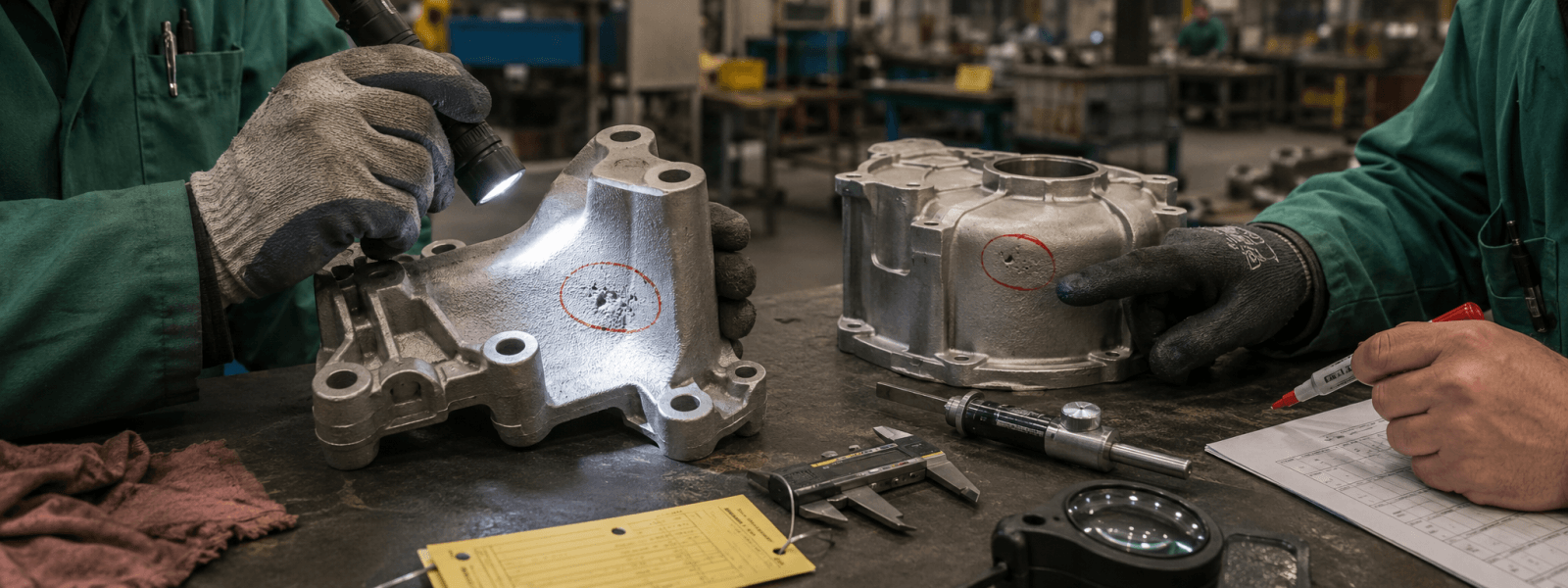
When a casting problem is found, it usually shows up late.
It may appear during machining, when a tool cuts into hidden porosity. It may show up during radiography, penetrant inspection, pressure testing, dimensional inspection, or final customer review. By that point, the casting may already represent hours of labor, consumed metal, mold and core work, finishing time, inspection cost, and delivery pressure.
But the problem itself often began much earlier.
That is one of the most important lessons in foundry problem solving. Technical problems are not always born where they are discovered. A defect may be found at inspection, but its origin may trace back to quoting, drawing review, tooling, gating, risering, charge material, melt practice, mold condition, core venting, pouring technique, or a customer requirement that was not clearly understood before production began.
Porosity is a good example.
Nearly every foundry has dealt with some form of porosity. It may be small, scattered, and mostly cosmetic. It may appear as rounded gas holes after machining. It may show up as shrinkage in a heavy section. It may create a leak path in a pressure-containing casting. It may cause a radiographic indication that delays shipment. It may be acceptable in one application and completely unacceptable in another.
That is why porosity cannot be treated as one simple problem.
In non-ferrous castings, porosity can come from several different sources. Gas porosity may be related to dissolved gas in the melt, mold or core gases, turbulence, moisture, or poor venting. Shrinkage porosity may result from inadequate feeding, isolated hot spots, poor riser placement, section changes, or solidification patterns that were not fully considered. Oxide films, dross, inclusions, and turbulent metal handling can create additional internal discontinuities or make other porosity problems worse.
The first mistake is assuming that all porosity has the same cause.
The second mistake is waiting until final inspection to start asking the right questions.
For a difficult casting, the earliest technical review matters. Before the job is quoted, the foundry should understand what the casting is expected to do. Is it pressure-containing? Will it be machined deeply? Are there sealing surfaces, bearing areas, threaded holes, or critical wall sections? Will the part be exposed to corrosion, fatigue, vibration, wear, heat, or impact? Are there radiographic requirements, leak requirements, or customer-specific acceptance standards?
Those questions matter because porosity does not matter the same way in every casting. A small internal void in a non-critical area may not affect function. That same void near a pressure boundary, machined surface, or fatigue-critical feature may be a serious issue. The foundry cannot evaluate risk properly unless it understands the service condition and the inspection expectation.
The drawing review is another place where problems begin or are prevented.
Heavy-to-thin section changes, isolated masses of metal, deep pockets, difficult cores, blind features, limited draft, sharp corners, and poor feeding paths can all create future problems. These are not just patternmaking details. They are quality risks. A geometry that creates a hot spot may also create shrinkage. A core that is difficult to vent may contribute to gas-related defects. A feature that looks simple on the drawing may be difficult to fill, feed, clean, inspect, or machine.
That does not mean the casting cannot be made. It means the risk needs to be recognized before the job becomes a promise.
Tooling and process planning also matter. Pattern condition, core box design, parting line location, gating layout, riser location, chills, filters, vents, coatings, and mold handling can all influence whether a casting is sound. A weak process plan may still produce a good casting once in a while, but it will not reliably produce good castings under normal production pressure.
Metal practice is another early source of later problems.
In aluminum castings, hydrogen control is often central to porosity prevention. In copper-base and other non-ferrous alloys, gas pickup, oxidation, dross, charge contamination, temperature control, and melt handling can all influence casting soundness. Even when the chemistry is correct, the melt can still carry quality risks if it has been overheated, held too long, handled turbulently, contaminated by poor charge materials, or poured in a way that folds oxides and dross into the casting.
Clean metal also has to stay clean.
A melt that leaves the furnace in good condition can still be damaged during transfer, ladling, skimming, pouring, or mold filling. Excessive drop height, splashing, poor ladle condition, interrupted pouring, aspiration, or uncontrolled flow can introduce oxides, turbulence, and entrained air. These are not theoretical concerns. They are ordinary foundry-floor variables that can determine whether a casting passes inspection or comes back as a problem.
Molds and cores deserve the same attention.
When porosity appears, it is tempting to look only at the metal. But mold moisture, binder gas, core venting, sand permeability, coating condition, mold hardness, mold damage, core storage, and vent path restrictions can all contribute to defect formation. A gas-related defect may not be a furnace problem at all. It may be a core problem, a venting problem, a mold preparation problem, or a timing problem between molding and pouring.
This is why good defect investigation should begin with a broad view.
When a porosity problem appears, the first question should not be, “Who caused this?” The first question should be, “What changed, and where could this have started?” Did the charge mix change? Did returns increase? Did a new supplier ship material? Did humidity change? Was there a new core package? Was a vent blocked? Did the pouring temperature drift? Did the job move to a different crew or shift? Was the casting machined in a new location? Did the inspection standard change? Did the customer apply a requirement differently than before?
The best foundries do not rely only on memory to answer those questions. They keep simple records that connect process conditions to results. They document heat numbers, charge notes, temperatures, mold and core conditions, gating or riser changes, inspection results, machining observations, and corrective actions. The goal is not paperwork for its own sake. The goal is to make the next investigation faster, clearer, and more useful.
That is also where the NFFS Technical Services Office can help.
Many foundries already know their own processes well. But even experienced teams can benefit from a more organized technical conversation. Sometimes the value is not in being told the answer. Sometimes the value is in slowing down the problem, separating possible causes, identifying the right next questions, and deciding what information is worth collecting before another heat is poured.
Technical problems in the foundry rarely begin at the moment they are discovered. They often begin earlier, in a decision that seemed small at the time: a requirement not clarified, a feature not questioned, a hot spot not addressed, a vent not opened, a melt held too long, a ladle not cleaned, a note not written down, or an inspection expectation not fully understood.
That is not a blame statement. It is an opportunity.
If foundries can look earlier in the process, they can often find better ways to prevent defects before they become rejects. Porosity may be discovered at machining, inspection, or pressure testing. But the path to solving it usually starts much farther upstream.
The earlier the foundry can see the risk, the better chance it has to control the outcome.