
Five Questions to Ask Before Quoting a Difficult Casting
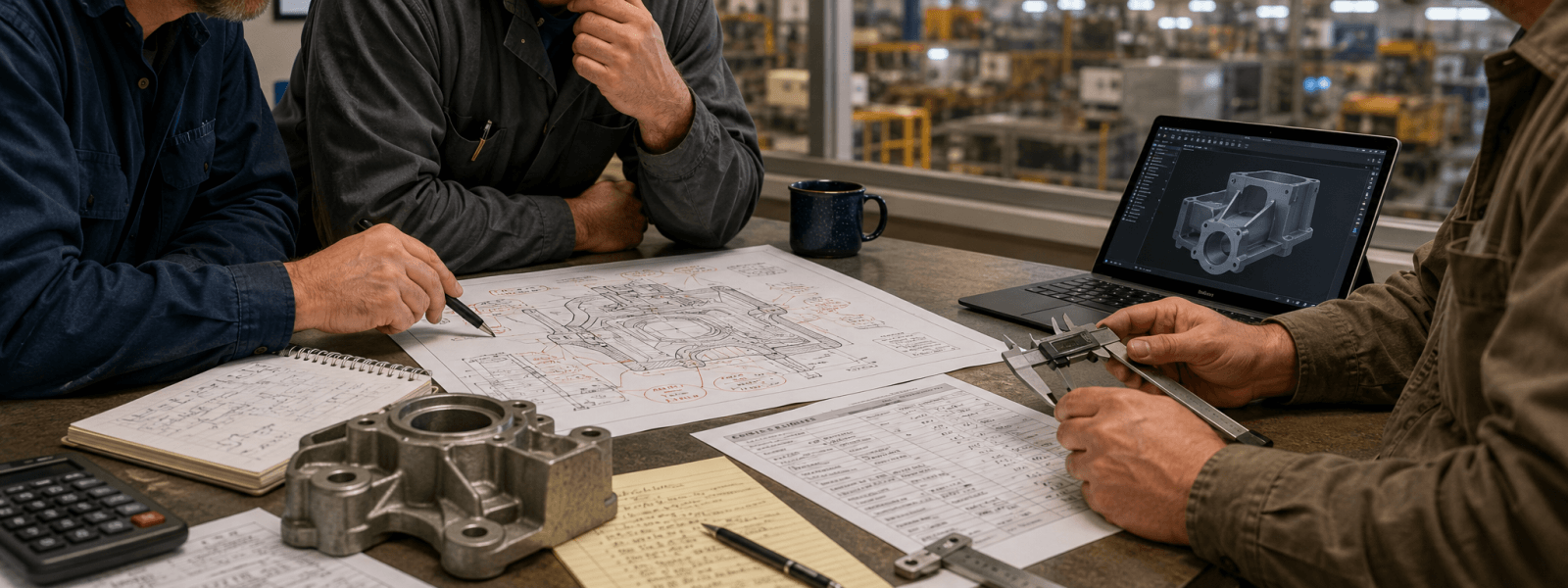
A difficult casting should not be quoted like a simple repeat job.
Before a foundry commits to price, delivery, tooling, inspection, or production assumptions, it is worth slowing down long enough to ask a few practical questions. The goal is not to make quoting slower. The goal is to avoid surprises that show up later as pattern changes, machining problems, inspection failures, rework, scrap, schedule pressure, or uncomfortable customer conversations.
Here are five questions worth asking before quoting a difficult casting.
1. What does this casting actually need to do?
The drawing may show the shape, but it may not explain the service condition. Is the casting pressure-containing? Load-bearing? Exposed to corrosion, wear, heat, impact, vibration, or fatigue? Will it be machined, welded, tested, coated, or assembled into a larger system? The more demanding the application, the more important it is to understand the real function before quoting the job.
2. What features make this casting difficult?
Some risks are visible before production begins. Heavy-to-thin section changes, isolated hot spots, deep pockets, tight corners, long cores, difficult parting lines, limited draft, thin walls, and hard-to-feed geometry can all affect cost and quality. A difficult feature does not always mean the job should be rejected, but it should be recognized before the quote becomes a promise.
3. Which requirements are truly critical?
Not every dimension, surface, or inspection requirement carries the same importance. Foundries should look carefully at tight tolerances, machined surfaces, sealing faces, datums, pressure boundaries, cosmetic surfaces, and inspection call-outs. A tolerance that looks harmless on a drawing may add cost or risk if it is applied to an as-cast surface that does not need that level of control.
4. What assumptions are being made about tooling, process, and volume?
A quote depends heavily on the production path. Is existing tooling available? Is it in usable condition? Will new pattern equipment or core boxes be needed? Is the job a prototype, a short run, or repeat production? Does the expected volume justify more robust tooling or process development? The cheapest tooling approach may not be the lowest-cost choice if it creates production problems later.
5. What needs to be clarified before the quote goes out?
If something is unclear, it should not be buried. Material grade, inspection level, acceptance criteria, repair limits, heat treatment, test bars, machining stock, documentation, packaging, and delivery expectations should be clarified early whenever possible. If an answer is not available, the quote should identify the assumption or exception clearly.
A good quote is more than a number. It is a technical judgment about what the casting will require to be made successfully.
For difficult castings, the best time to find the risk is before the quote leaves the foundry.