
Three Places Clean Metal Can Get Dirty Again
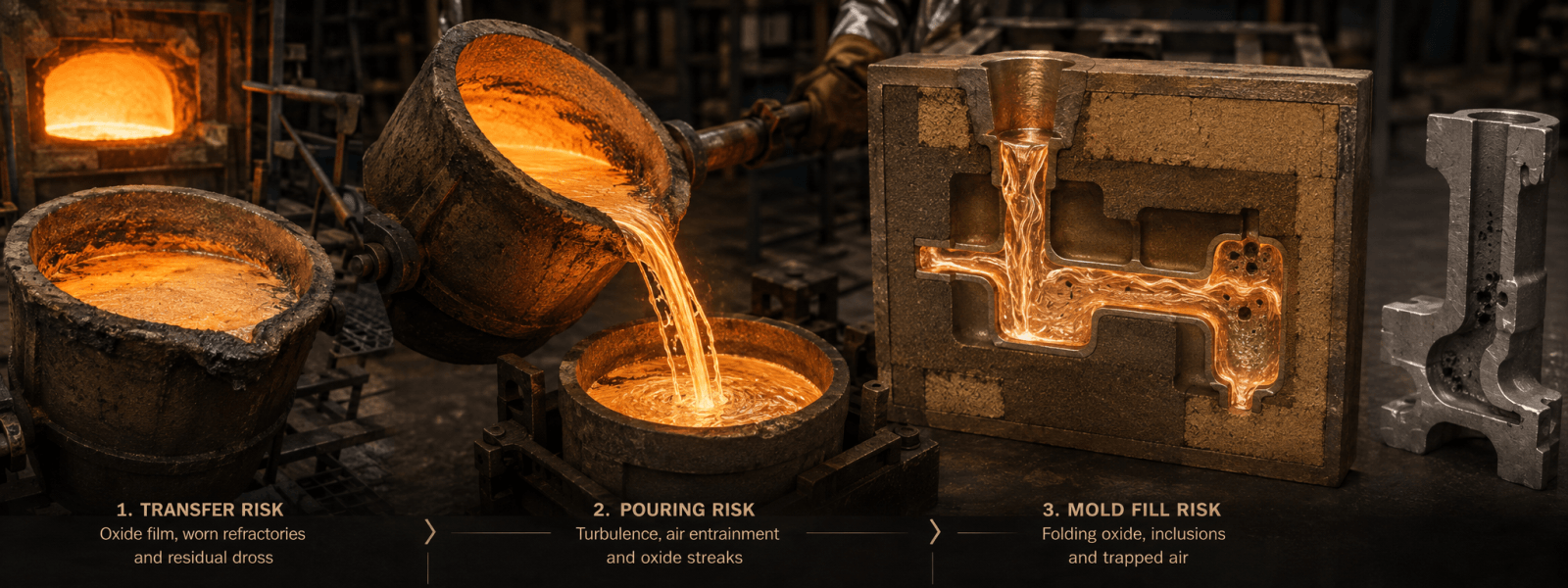
A clean melt is not a permanent condition.
A foundry can do a great deal right before casting: control the charge, verify chemistry, skim carefully, degas, flux where appropriate, allow inclusions to separate, and filter the metal. Yet the metal that leaves the furnace is not necessarily the same metal that arrives in the casting. Melt treatment may create the cleanliness you want, but everything that happens afterward has to preserve it.
That matters throughout the non-ferrous industry, especially in aluminum-bearing systems. Liquid aluminum develops an oxide film almost immediately when exposed to air. If that film remains on the surface, it may cause little trouble. If the surface is folded, splashed, or submerged by turbulence, however, the oxide can be carried into the melt as a double oxide film, often called a bifilm. Nickel aluminum bronze presents a related challenge: aluminum’s strong affinity for oxygen can create internal oxide inclusions when surface films or dross become entrained.
So the practical question is not only “Did we clean the metal?”
It is also “Did we keep it clean?”
Here are three places where that cleanliness can be lost.
1. The Transfer Ladle
The first opportunity may appear the moment metal leaves the furnace.
Transfer gives the melt a new container, a new refractory surface, more exposure to the atmosphere, and another opportunity for the surface to be disturbed. A ladle or launder may also carry oxide buildup or deteriorated refractory from previous service. Research supported by the U.S. Department of Energy and Oak Ridge National Laboratory has documented corrosion and wear mechanisms in refractory materials used in molten-aluminum contact applications, including degradation around the metal line.
The transfer itself matters just as much. Research examining aluminum metal quality has specifically identified deterioration associated with turbulent transfer and a large fall of liquid metal between vessels. In other words, metal that was cleaned successfully in one furnace can be recontaminated simply while being moved to the next stage.
The melt surface deserves respect too. Dross that has already separated is exactly where you want it: outside the bulk liquid metal. Aggressive transfer, unnecessary agitation, or disturbing accumulated surface material can put contaminants back into circulation.
This is why a “clean furnace” is only the starting point.
A useful shop-floor question is:
What does the metal touch between treatment and the mold?
2. The Pouring Stream
The second place is probably the easiest to underestimate.
A pouring stream can manufacture new inclusions in seconds.
For aluminum alloys, the oxide film on the liquid surface forms extremely quickly. Surface turbulence can fold that film into the metal and trap air between oxide surfaces. Experimental casting research has demonstrated the relationship between surface turbulence, entrained oxide films, internal discontinuities, and reduced casting integrity.
The same principle matters in aluminum bronzes. Copper Development Association guidance on nickel aluminum bronze notes that oxide inclusions historically presented a significant obstacle to successful casting and describes the development of non-turbulent casting methods specifically intended to avoid detrimental oxide entrainment.
That means a furnace sample can look excellent while the final casting does not.
The contamination may have been created after the sample was taken.
Excessive free fall, splashing, an interrupted stream, excessive velocity, or a runner system that lets the advancing metal fold back over itself can undo careful upstream treatment. Research on aluminum gating systems has shown that controlling flow velocity and turbulence can reduce oxide-related defects and porosity.
Filtration remains valuable, but a filter is not permission to pour badly. It can remove existing inclusions and help control flow, but oxide created downstream of the filter is still downstream of the filter.
The question at this stage becomes:
Where does the metal fall, splash, separate, or roll over itself?
3. Inside the Mold
The third place is the one operators cannot see once the pour begins.
Metal can arrive at the mold entrance in excellent condition and still become contaminated during filling.
The mold is not simply a passive container. The stream changes direction, divides, passes through runners and ingates, moves around cores, and spreads through the cavity. Experimental work examining aluminum flow in sand molds has reinforced how important casting hydrodynamics are because unstable filling can contribute to bifilms, oxide inclusions, porosity, and ultimately scrap.
The molding system can also become a source of physical contamination. Recent experimental work with aluminum sand castings identified sand inclusions among the defects affected by molding-sand condition and demonstrated the importance of factors such as mold strength, hardness, grain fineness, permeability, and moisture control.
This is why a good gating system does more than simply get the cavity full.
It manages how the metal arrives.
The objective is to maintain a controlled metal front, limit unnecessary surface creation and violent impingement, and give air and gases a reasonable path out rather than turning the mold cavity into a mixing chamber.
The useful question here is:
What happens to the metal after it disappears below the pouring basin?
Cleanliness Is a Chain
Melt cleanliness should be treated almost like a chain of custody.
Degassing does not protect metal from a contaminated transfer system. Skimming does not protect it from a turbulent pour. Filtration does not protect it from turbulence created after the filter. Clean charge material does not protect it from deteriorating refractory. And a well-treated melt cannot protect itself inside a poorly controlled filling system.
For non-ferrous foundries, that distinction is particularly important because many valuable alloy systems are highly responsive to what happens while they are liquid. Aluminum alloys and aluminum-containing copper alloys reward disciplined handling and give foundries very little benefit for cleaning metal carefully only to disturb it again later.
When a cleanliness-related defect appears, the investigation therefore should not stop at the furnace.
Ask where the metal changed containers.
Ask what it touched.
Ask where its surface was disturbed.
Ask where it fell.
Ask where the flow became unstable.
The most useful question may not be:
“Was the metal clean?”
It may be:
“How long did we keep it clean?”