
SAM.gov Set Aside Classifications and Why They Matter
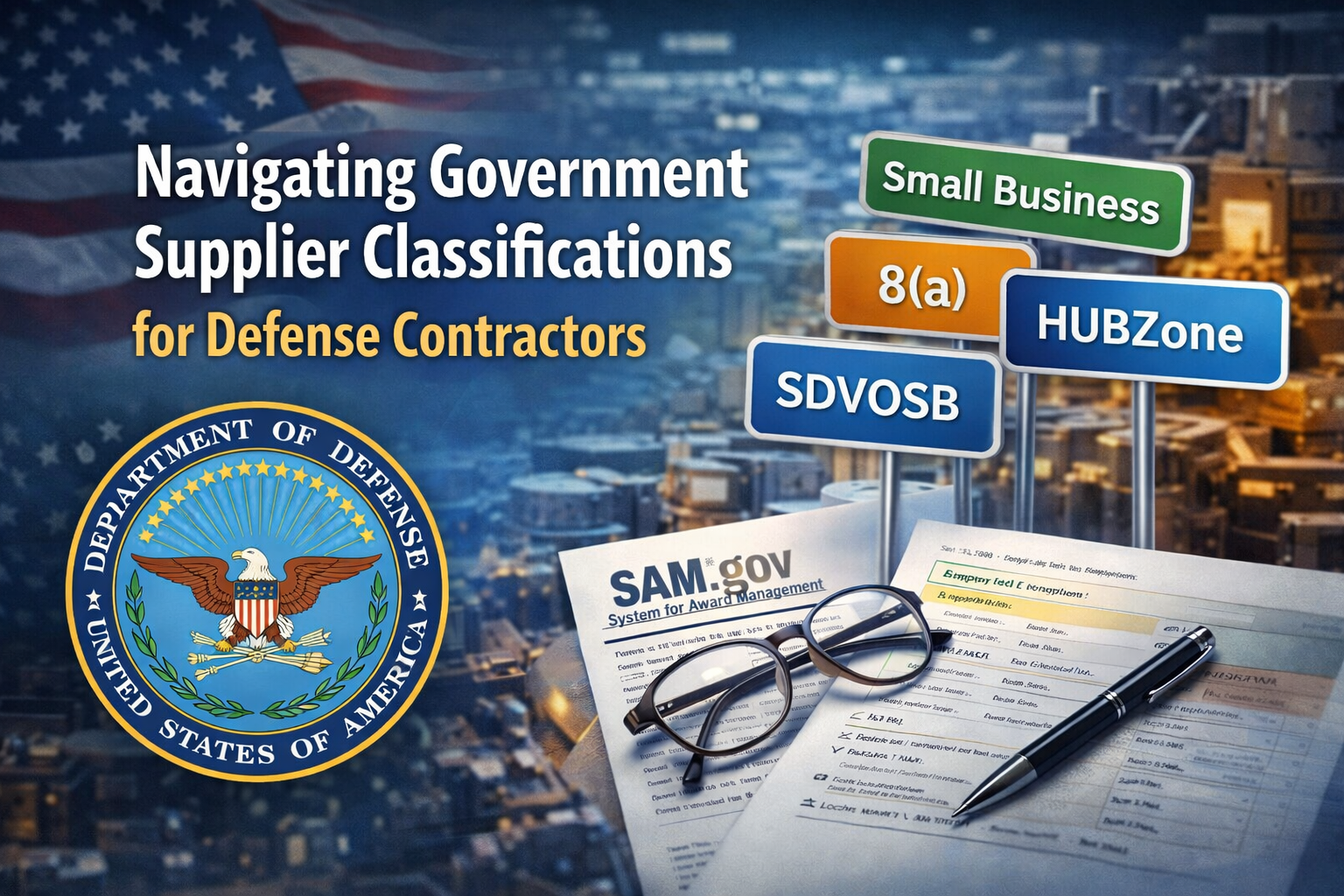
A Practical Guide for Casting, Forging, and Machine Shop Companies Supporting Defense Contractors
For casting, forging and machine shop companies supplying the U.S. Department of Defense (DoD), understanding government-recognized business types is not optional—it is a strategic requirement. Prime contractors such as Lockheed Martin, Raytheon (RTX), Northrop Grumman, General Dynamics, and Boeing rely heavily on qualified small and socioeconomic businesses to meet federal subcontracting goals.
These classifications—commonly referred to a socioeconomic designation—can determine whether your company:
- Is eligible for set-aside prime contracts
- Is selected as a preferred subcontractor
- Receives evaluation advantages in competitive procurements
This article explains key business types (SB,HUBXone, 8(a) etc.) and provides defense-specific considerations and real-world examples relevant to manufacturing firms.
Why Business Type Classification Matters in Defense Contracting
Federal Acquisition Regulation (FAR) requirements mandate that large defense primes:
- Meet small business subcontracting goals
- Report performance in systems like eSRS (Electronic Subcontracting Reporting System)
- Actively seek qualified small and diverse suppliers
Implications for manufacturers: If your company is properly certified, you are more likely to be:
- Included in supplier databases
- Invited to bid on RFQs/RFPs
- Selected to support long-term defense programs
Key Government Business Types (Defense Context)
1. Small Business (SB) – A business that meets SBA size standards based on NAICS codes. Manufacturing benchmark- typically <500 employees for many machining, forging and casting NAICS codes.
- Example: A 120-employee precision machine shop in Ohio supplies mil-spec components to General Dynamics Land Systems for armored vehicle program. As a Small Business, it helps the prime meet subcontracting goals.
- What to Consider: Confirm NAICS alignment (e.g.,332710 Machine Shops), Monitory employee count and affiliations, and maintain SAM registration accuracy.
2. HUBZone Small Business- A small business operating in economically distressed areas with workforce residency requirements. Core Requirements- HUBZone principal office and 35% of employees live in HUBZone areas.
- Example: A casting foundry located in a designated HUBZone in Pennsylvania supplies components to BAE Systems. The HUBZone status gives the prime additional credit toward subcontracting goals and increases the foundry’s attractiveness.
- What to consider: Physical plant location (not just office), Workforce tracking and documentation and ongoing compliance (auditable). Strategic Advantage: Primes often actively search for HUBZone suppliers to fill gaps in subcontracting plans.
3. 8(a) Small Disadvantaged Business – A small business owned by socially and economically disadvantaged individuals and admitted into the SBA’s (8(a) program. Program duration: 9 years.
- Example: An 8(a)-certified machining company wins a sole-source contract to produce specialized aerospace brackets for a subcontractor supporting Lockheed Martin’s F-35 program.
- What to Consider: Ownership and control must be real and documented, be prepared for audits and annual reviews and develop relationships with DoD small business offices. Strategic Advantage: Access to sole-source DoD awards (no competition required below thresholds).
4. Service -Disabled Veteran-Owned Small Business (SDVOSB)- A small business owned and controlled by service-disabled veterans.
- Example: A veteran-owned CNC machining firm becomes a preferred supplier to Raytheon(RTX) for missile system components, helping fulfill SDVOSB subcontracting goals.
- What to Consider: Veteran must control operations and decisions, and Certification must be active (VetCert). Strategic Advantage: High demand among primes with defense contracts and strong alignment with DoD supplier diversity initiatives.
5. Veteran-Owned Small Business (VOSB)- Businesses owned and controlled by women, with EDWOSB including economic disadvantage criteria.
- Example: A woman-owned precision machining company in Texas secures subcontract work on naval systems through Huntington Ingalls Industries, helping meet WOSB participation goals.
- What to Consider: Ownership must be at least 51%, women must control daily operations and Certification must be current.
6. Woman -Owned Small Business (WOSB/EDWOSB)- Businesses owned and controlled by women, with WOSB participation goals.
- Example: A woman-owned precision machining company in Texas secures subcontract work on naval systems through Huntington Ingalls Industries, helping meet WOSB participation goals.
- What to consider: Ownership must be at least 51%, women must control daily operations and Certifications must be current.
7. Size and Affiliation Risks- The SBA evaluates: Parent companies, Shared ownership and Joint ventures.
8. Limitations on Subcontracting (Critical)- For small business set-asides, the small business must perform a required portion of the work. For manufacturing, it must be the manufacturer or must comply with the Nonmanufacturer Rule.
In conclusion, for casting, forging and machining companies in the defense sector, government business classifications are more than labels---they are access points into the defense industrial base. Companies that properly align their NAICS codes, maintain valid certifications, understand subcontracting rules and meet defense compliance standards are significantly better positioned to work with major defense contractors. Success in this space required both regulatory alignment and operational excellence. Businesses that treat certification as part of a broader market strategy—not just paperwork—gain a measurable competitive advantage.