
R3 Is Not an Audit: What Foundries Should Know
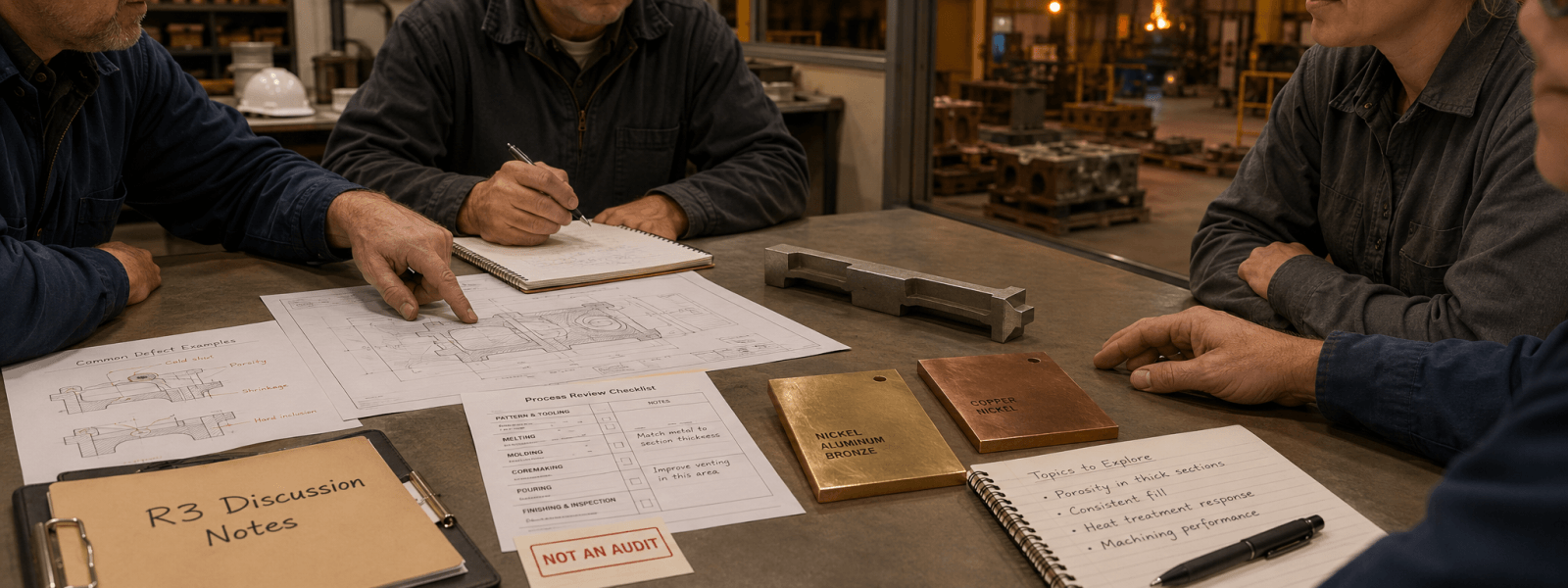
When foundries hear about a program focused on reject rates, it is natural to wonder what that really means. Is someone coming in to inspect our operation? Will our data be used against us? Are we being asked to admit problems in front of customers or competitors?
For the NFFS Reject Rate Reduction Program, also known as R3, the answer is simple: no.
R3 is not an audit. It is not an inspection. It is not a certification program, compliance review, customer investigation, or fault-finding exercise. NFFS is not looking to assign blame, rank foundries, expose company-specific problems, or tell individual companies how to run their operations.
R3 is intended to be a practical technical resource for the non-ferrous foundry industry.
The program begins with a focused look at Nickel Aluminum Bronze and Copper-Nickel alloy castings because these materials are important to marine, naval, defense, industrial, and infrastructure applications. They are also alloy families where quality, process discipline, inspection requirements, and customer expectations can be demanding. Many foundries already understand the frustration of recurring rejects, unclear root causes, delayed approvals, difficult repairs, or quality issues that appear late in the production process.
R3 is being built to help the industry better understand those recurring challenges and develop useful guidance that can support better outcomes.
That starts with listening.
NFFS wants to hear from member foundries with real experience in NAB, Cu-Ni, and related copper-base alloy work. What defects are most common? Where do problems tend to appear? What inspection requirements create the most difficulty? What process variables deserve more attention? What customer expectations are unclear or inconsistent? Where would practical industry guidance actually help?
The purpose is not to collect sensitive company information for public release. The purpose is to identify common themes across the industry so NFFS can help develop shared tools, best practices, educational resources, and recommendations that are useful to foundries, suppliers, customers, and technical stakeholders.
Participation can take several forms. A foundry may volunteer for the R3 Steering Committee, join a discussion, provide general technical input, share non-confidential observations, participate in a briefing, or help review practical guidance as it is developed. Not every company needs to provide the same level of detail. Even a short conversation can help NFFS better understand where the real barriers are.
Although the initial focus is NAB and Cu-Ni, the lessons learned through R3 are expected to have broader value across non-ferrous casting operations. Issues such as melt cleanliness, gating, feeding, inspection planning, repair discipline, specification clarity, and customer communication are not limited to one alloy family.
That is why foundry participation matters.
R3 will be strongest if it reflects actual foundry experience, not assumptions made from a distance. NFFS member foundries have the practical knowledge needed to make this program useful, realistic, and worth the industry’s time.
If your foundry casts NAB, Cu-Ni, or related non-ferrous alloys, NFFS encourages you to take a closer look at R3 and consider getting involved.
This is not about blame.
It is about helping the industry solve shared problems together.