
Why Reject Rate Reduction Starts Before the Pour
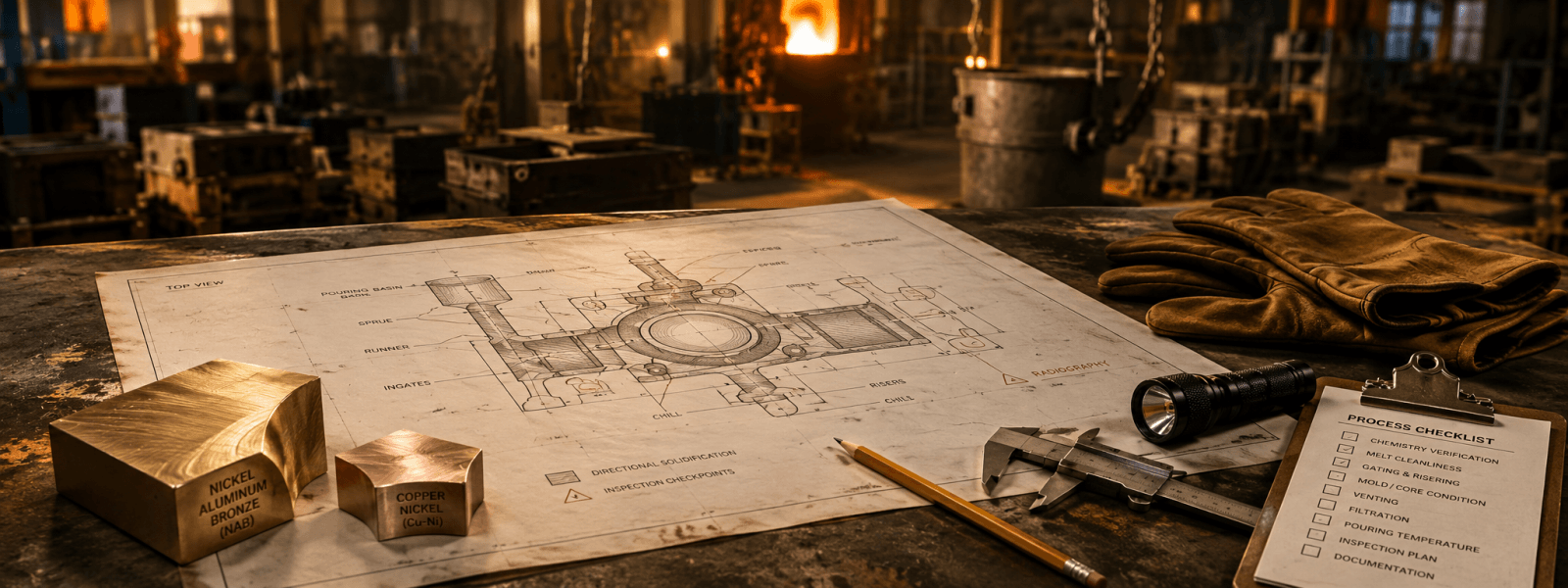
When a casting is rejected, the problem often appears late in the process.
It may show up during machining. It may appear during radiographic inspection, liquid penetrant testing, pressure testing, dimensional inspection, or final customer review. By the time the defect is visible, the casting may already represent hours of labor, consumed material, occupied equipment, delayed delivery, and a frustrated customer.
But many reject-related problems do not begin at inspection. They begin much earlier.
In many cases, reject rate reduction starts before the pour.
That idea is especially important for the Nickel Aluminum Bronze and Copper-Nickel alloy families currently at the center of the NFFS Reject Rate Reduction Program, also known as R3. These alloys are used in demanding marine, naval, defense, industrial, and infrastructure applications where quality, reliability, corrosion resistance, and service performance matter. They can be excellent casting alloys when properly controlled. They can also be unforgiving when process discipline is weak.
Nickel Aluminum Bronze, commonly called NAB, is a good example. NAB is valued because it combines strength, corrosion resistance, wear resistance, toughness, and performance in seawater and other severe service environments. But the same chemistry that makes NAB valuable also makes it sensitive to how the metal is melted, handled, transferred, poured, fed, cooled, heat treated, inspected, and repaired.
Aluminum helps give NAB its corrosion resistance by supporting the formation of a protective oxide film in service. On the foundry floor, however, aluminum’s strong affinity for oxygen can become a quality risk. If the melt is handled turbulently, oxide films and dross can become entrained in the casting. These internal defects may not always look dramatic at first, but they can contribute to leak paths, fatigue concerns, machining problems, inspection failures, or reduced service confidence.
That is why “before the pour” matters.
Before the pour is where charge materials are selected and controlled. It is where chemistry targets are understood, verified, and adjusted. It is where furnace practice, melt cleanliness, temperature control, slag and dross handling, ladle condition, transfer practice, gating design, risering strategy, mold preparation, core condition, venting, filtration, and pouring discipline all begin to shape the final casting.
For NAB and Cu-Ni castings, these decisions are not small details. They are part of the quality system.
Copper-Nickel alloys bring their own discipline requirements. They are often selected for seawater service, corrosion resistance, and reliability in demanding applications. As with NAB, successful Cu-Ni casting depends on more than simply meeting a chemical specification. Foundries must control melt quality, gas pickup, mold conditions, feeding, solidification, cleanliness, and inspection expectations. A casting that meets chemistry but carries shrinkage, porosity, inclusions, surface discontinuities, or repair-related concerns may still fail to meet the customer’s actual need.
This is one of the central lessons behind R3: reject rate reduction is not just an inspection activity. Inspection is necessary, but inspection alone does not create quality. Inspection tells us what happened. Process discipline helps determine what happens next time.
When recurring rejects appear, the industry’s first instinct can sometimes be to focus only on the visible defect. Was it shrinkage? Gas? Dross? Sand? A crack? A dimensional miss? A weld repair issue? Those questions matter, but R3 is intended to help the industry look deeper. What production conditions allowed the defect to form? Was the casting design difficult to feed? Was the gating too turbulent? Was the melt held too long? Was the mold too wet, too tight, poorly vented, or inconsistent? Were inspection requirements clearly understood before production began? Did the foundry and customer have the same definition of acceptable quality?
These are practical questions, not blame questions.
That distinction is important. R3 is not an audit, inspection, or fault-finding program. It is intended to be a collaborative technical resource for foundries, suppliers, customers, and other stakeholders. The goal is to identify recurring quality and production challenges, better understand common root causes, and develop practical guidance that helps reduce avoidable rejects, improve delivery performance, and strengthen confidence in U.S.-made non-ferrous castings.
Although R3 begins with a focused look at Nickel Aluminum Bronze and Copper-Nickel alloy castings, the lessons are much broader. Every alloy family has its own sensitivities, but the larger pattern is familiar across the foundry industry. Aluminum alloys, manganese bronze, silicon bronze, brass, magnesium, zinc, iron, steel, and specialty alloys all reward disciplined control of the process before metal enters the mold.
Good castings are not made by inspection at the end. They are made through decisions across the entire process.
That includes early communication with the customer about application, service environment, acceptance criteria, inspection level, repair limits, pressure requirements, machining stock, delivery schedule, and documentation expectations. It includes engineering review before tooling or production changes become expensive. It includes foundry-floor practices that reduce turbulence, prevent contamination, support directional solidification, and match inspection methods to real service risk.
Reject rate reduction, in other words, is not one department’s responsibility. It is not only quality control. It is not only engineering. It is not only melting, molding, pouring, finishing, or inspection. It is the combined result of many connected decisions.
That is why R3 matters.
By bringing foundries, technical personnel, suppliers, customers, and industry stakeholders into the same conversation, NFFS hopes to help the non-ferrous foundry industry build better shared understanding around recurring reject drivers. The immediate focus is NAB and Cu-Ni because these alloys are important, demanding, and highly relevant to domestic supply chain performance. But the long-term value is larger: practical tools, clearer communication, better data, stronger technical habits, and a more confident U.S. casting supply base.
For foundries working with NAB and Cu-Ni, the message is simple: quality starts early. It starts with the question asked before the job is quoted, the specification reviewed before production begins, the gating reviewed before the mold is made, the metal handled before it is poured, and the process choices made before the casting ever reaches inspection.
Rejects may be discovered at the end.
But reject rate reduction starts before the pour.