
Nickel Aluminum Bronze: A High-Performance Alloy Family That Rewards Foundry Discipline
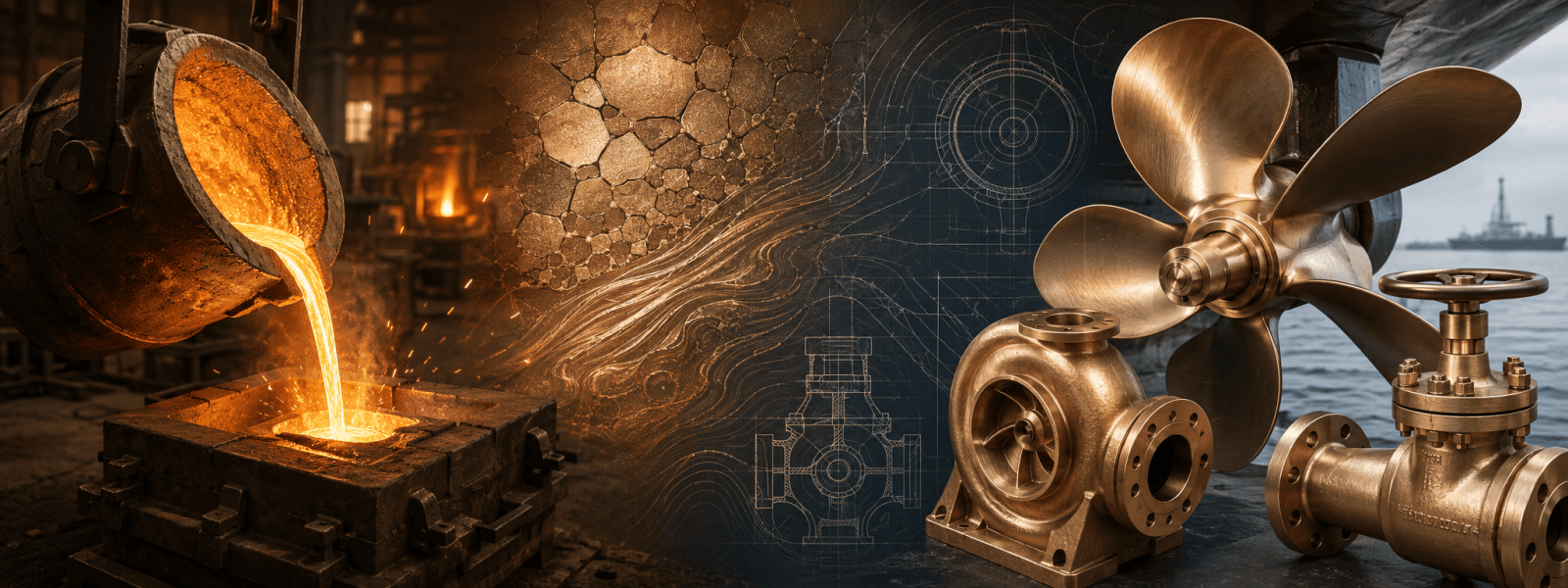
Nickel Aluminum Bronze: A High-Performance Alloy Family That Rewards Foundry Discipline
Nickel aluminum bronze, often shortened to NAB, is one of the most important high-performance alloy families in the non-ferrous foundry world. It is best known for marine service, especially propellers, pump and valve components, seawater hardware, bushings, bearings, and other demanding parts that must survive corrosion, wear, impact, fatigue, and heavy mechanical loading. But NAB is not only a “marine alloy.” It is a broader family of copper-aluminum alloys strengthened and stabilized with nickel, iron, and often manganese, giving it a combination of properties that few cast materials can match.
For NFFS members, the practical lesson is simple: nickel aluminum bronze can be an outstanding alloy when it is melted, poured, fed, inspected, heat treated, and repaired correctly. It can also be unforgiving when process control is weak. The same chemistry that gives NAB its corrosion resistance and strength also makes it sensitive to oxide inclusions, shrinkage, turbulence, microstructural variation, and repair-related corrosion concerns. In other words, NAB is not just a chemistry. It is a process discipline.
What Makes Nickel Aluminum Bronze Different?
The base of the alloy is copper and aluminum. Nickel and iron are then added to improve strength, corrosion resistance, wear behavior, and stability of the final microstructure. Manganese may also be present as both a deoxidizing and strengthening addition. Common cast NAB grades include alloys such as C95500, C95520, C95800, and C95820, with C95800 especially common in seawater and marine service. Wrought relatives such as C63000 and C63200 are widely used where forged, extruded, or rolled product forms are required.
The family is valued because it brings together several useful properties in one material: high strength, good corrosion resistance, good wear and galling resistance, resistance to cavitation and erosion-corrosion, non-sparking behavior, relatively low magnetic permeability in selected grades, and good toughness across a wide range of service conditions. This is why NAB appears in applications where failure is costly, visible, or mission-critical.
The alloy’s corrosion resistance comes in part from the formation of a protective aluminum-rich oxide film on the surface. That film is one of NAB’s great strengths in service. On the foundry floor, however, aluminum’s strong affinity for oxygen becomes a major quality consideration. Aluminum oxide can form in the melt and become entrained into the casting if metal handling is turbulent. Those oxide films and dross inclusions can become internal defects that reduce fatigue life, create leak paths, interfere with machining, or become initiation sites for corrosion.
That dual nature is what makes NAB fascinating: the same aluminum that helps protect the finished casting can also create serious casting defects if the melt is not handled correctly.
Where NAB Is Used
NAB is most strongly associated with seawater service, including ship and submarine components, propellers, pump housings, valve bodies, impellers, sleeves, bushings, and other hardware exposed to saltwater or moving fluid. It is also used in oil and gas, desalination, chemical processing, aerospace bearings, heavy equipment, and architectural applications. In many of these uses, the alloy is selected not for a single property, but for its combination of strength, corrosion resistance, wear resistance, and reliability.
For foundries serving defense, marine, energy, or industrial markets, NAB can therefore represent a high-value alloy family. It is also an alloy family where customer expectations can be demanding. Castings may require radiography, liquid penetrant testing, ultrasonic inspection, hydrostatic testing, chemistry verification, mechanical test bars, weld repair qualification, or documentation tied to ASTM, military, or customer-specific requirements.
Why NAB Can Be Challenging to Cast
NAB castings are commonly produced by sand casting, shell molding, ceramic mold casting, investment casting, permanent mold casting, centrifugal casting, and continuous casting. Each route has its own strengths and defect risks, but several themes apply across the family.
First, NAB is sensitive to turbulence. A gating system that creates excessive free fall, splashing, aspiration, or reoxidation can fold oxide films into the casting. These bifilm-type defects may not always appear as obvious inclusions, but they can act like internal cracks or weak planes. This is why quiet, controlled filling is so important.
Second, NAB must be fed carefully. Many NAB grades have significant solidification shrinkage. If the casting is not designed for directional solidification, or if hot spots are not properly fed, shrinkage cavities and microshrinkage can form. These are especially serious in pressure-containing components, rotating components, and parts subject to fatigue.
Third, gas and mold-related defects still matter. Poor venting, damp molds or cores, excessive binder gas, trapped air, or poor melt practice can create porosity. Sand, ceramic, slag, dross, and oxide inclusions may also occur if mold integrity, filtering, skimming, or pouring discipline is poor.
Fourth, microstructure matters. NAB is not a simple single-phase alloy. Its performance depends on the balance of copper-rich alpha phase, transformed beta, and kappa phases that contain iron, nickel, and aluminum. Chemistry, cooling rate, section size, and heat treatment all influence the final structure. In seawater service, retained or improperly transformed phases can make the alloy more vulnerable to selective phase corrosion.
The Foundry Controls That Matter Most
For most NAB casting problems, the best solutions are found before the metal enters the mold.
A strong NAB process should begin with disciplined charge control and chemistry verification. Aluminum, nickel, iron, manganese, and impurity levels all matter. The melt should be handled to minimize oxidation, dross formation, and turbulence. Transfer, skimming, ladle practice, pouring height, gating design, and filtration should be treated as quality-critical variables.
Gating should promote calm, controlled mold filling. Bottom-filling approaches, properly sized runners and ingates, and avoidance of excessive velocity are all important. Casting simulation can be particularly useful for NAB because it allows the foundry to evaluate fill behavior, hot spots, misrun risk, oxide formation risk, and feeding before tooling or process changes become expensive.
Risering and chilling should be designed around directional solidification. Shrinkage defects in NAB are often not “mystery defects.” They usually point to a feeding path that was interrupted, a riser that froze too soon, a hot spot that was not addressed, or a geometry that needs a more thoughtful thermal strategy.
Inspection should match the risk of the casting. Visual inspection remains the first line of defense, but many NAB applications require more. Liquid penetrant inspection is valuable for surface-breaking cracks, cold shuts, laps, and repair verification. Radiography and computed tomography are useful for internal shrinkage, gas porosity, dross, sand, and oxide-related defects. Ultrasonic inspection can be useful in wrought or fine-grained product forms. Pressure testing is essential where leak-tightness is part of the service requirement.
Repair Requires Special Care
Weld repair of NAB castings can be appropriate in some applications, but it should never be treated casually. The governing specification, customer requirement, and service condition must determine whether repair is allowed. Some specifications restrict or prohibit repair, while other marine or industrial applications may allow qualified weld repair under controlled procedures.
When weld repair is permitted, the defect must be completely removed, the excavation must be properly shaped and cleaned, and inspection should verify sound metal before repair metal is deposited. After welding, the repaired area may require post-weld heat treatment, particularly for seawater service, to restore a corrosion-resistant microstructure. Without proper heat treatment, retained beta or weld-altered microstructure may become more vulnerable to selective phase attack.
This is one of the most important points for foundries and casting users: a repaired NAB casting is not automatically equivalent to the original casting. It becomes equivalent only when the repair procedure, filler metal, cleaning, inspection, heat treatment, and final verification are all properly controlled.
What NFFS Members Should Take Away
Nickel aluminum bronze is a premium alloy family for demanding service. Its value comes from the way chemistry, microstructure, casting practice, heat treatment, and inspection work together. When those variables are controlled, NAB offers an exceptional balance of strength, corrosion resistance, wear resistance, toughness, and service life. When they are not controlled, the alloy can reveal defects quickly and unforgivingly.
For foundries, NAB rewards investment in process discipline: clean melting, calm pouring, thoughtful gating, strong feeding, good simulation practices, appropriate inspection, and careful repair procedures. For casting buyers and end users, NAB rewards clear specifications, realistic inspection requirements, and early communication with the foundry about service conditions and acceptance criteria.
The broader lesson is that NAB is not just a material selection. It is a system of decisions. The best results come when the foundry, customer, engineer, machinist, inspector, and repair team all understand what the alloy is capable of—and what it demands in return.
For NFFS members, this makes nickel aluminum bronze an ideal example of why practical metallurgy still matters. The alloy performs beautifully when its invisible structure is respected. And that structure begins on the foundry floor.