
How to Use Reject Data Without Blaming People
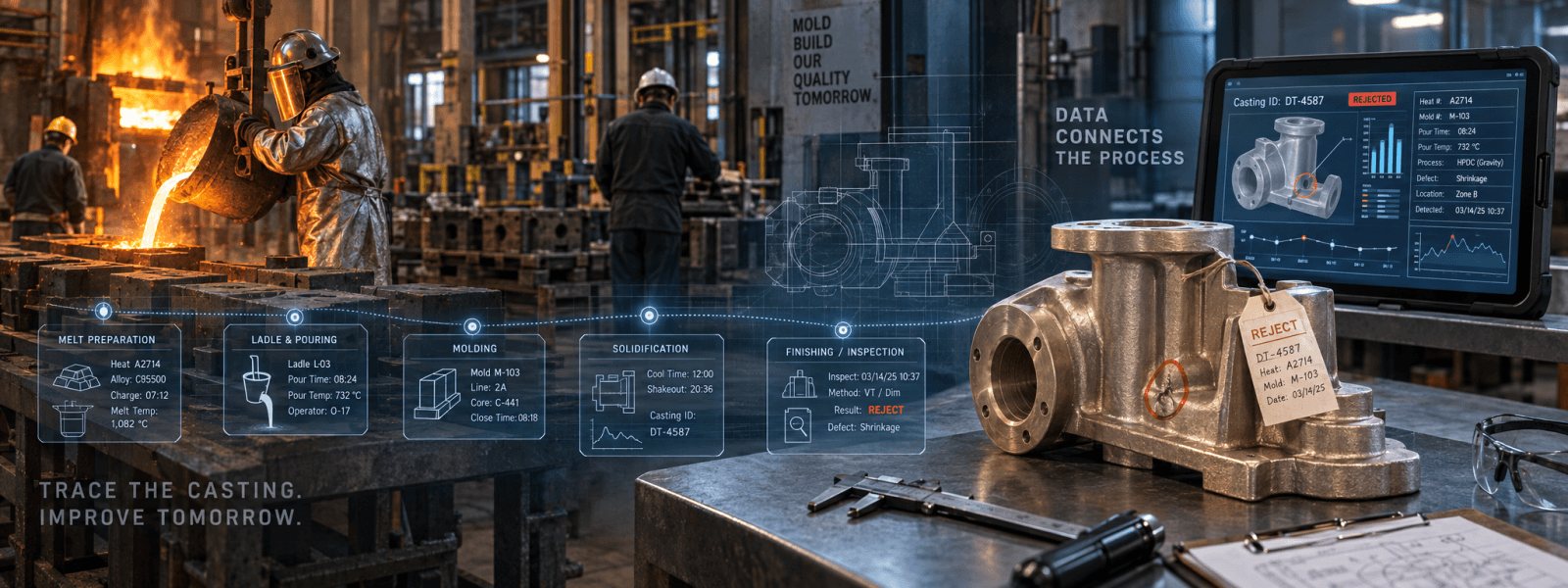
Most foundries collect reject data in one form or another. Scrap is counted. Rework is tracked. Defect codes are assigned. Quality reports are generated. Customer returns are documented. In many operations, those numbers eventually find their way into spreadsheets, production meetings, management reviews, or monthly quality summaries.
The harder question is whether that information is actually helping the foundry make better castings.
Reject data can be one of the most valuable technical resources available to a foundry because it contains a record of where the process did not produce the expected result. Used correctly, it can reveal patterns involving parts, alloys, tooling, molding conditions, pouring practices, inspection methods, production sequences, or other process variables. Used poorly, however, the same data can quickly become a mechanism for deciding which department, shift, or employee should receive the blame.
Once that happens, some of the most useful information tends to disappear.
The first purpose of reject data should be to describe what happened accurately enough that the process can be investigated. It should not be to decide, before the investigation begins, who caused it.
Start With What Actually Happened
A reject code is not necessarily a root cause.
“Porosity” describes an observation. “Shrinkage” may describe a defect mechanism more specifically, but additional questions still remain. “Bad metal,” “operator error,” and “failed inspection” tell us even less. The more quickly a label becomes an explanation, the greater the risk that the investigation stops before the actual cause is understood.
A better reject record captures enough detail to reconstruct the event. Where was the indication located? What did it look like? Was it internal or surface-breaking? Was it concentrated in a heavy section, near a riser, around a core, or at a machined surface? Was it found visually, during machining, through radiography, by liquid penetrant inspection, during pressure testing, or after shipment?
This distinction between where a problem was found and where it was created is particularly important. A machinist may uncover porosity, but machining did not necessarily create it. Radiography may identify shrinkage, but the X-ray process did not cause the feeding problem. Inspection shows us something about the casting. It does not automatically tell us where in the manufacturing process the problem originated.
That is why good reject analysis starts with a principle that applies to almost every technical investigation: describe the problem before guessing the cause.
A Percentage Is Not a Diagnosis
Reject rate is useful, but it is only the beginning.
If a foundry reports a 6% reject rate for the month, management has learned something important about overall performance. It has not yet learned what needs to change. Six percent could represent one troublesome casting family, several unrelated defects, a temporary tooling issue, a demanding new job, a change in inspection requirements, or a broader process-control problem.
The value begins to emerge when the data is separated into meaningful groups. Rejects can be examined by part number, casting family, alloy, defect type, defect location, tooling configuration, heat, lot, inspection method, production period, or other relevant variables. The right categories will vary by foundry and process, but the objective is the same: find patterns that would otherwise disappear inside the overall percentage.
A total reject rate tells you how much of a problem you have. Good stratification begins to tell you what kind of problem you have.
That distinction becomes even more important when comparing people or shifts.
Suppose one shift has a higher reject rate than another. That observation should not be ignored, but neither should it become the conclusion. Does that shift run the same products? Does it use the same equipment? Does it receive more difficult jobs? Does it pour later in a furnace campaign? Are mold conditions, temperatures, holding times, maintenance practices, staffing levels, or inspection practices different?
The same caution applies when data appears to follow one operator. The operator may ultimately be an important variable, but there are still more questions to ask. What equipment does that person normally operate? What jobs are they assigned? What training have they received? Are the written procedures clear? Are experienced operators compensating for process problems through undocumented techniques that newer employees have never been taught?
People can absolutely be part of the data. They simply should not become the root cause by default.
No Blame Does Not Mean No Accountability
This is not an argument for eliminating individual accountability. Procedures can be ignored. Measurements can be missed. Instructions can be misunderstood. Employees sometimes make poor decisions, and those situations need to be addressed.
The technical investigation should still continue.
If an employee operated outside the established process, why was that deviation possible? Was the standard understood? Was the required training completed? Was the necessary equipment working and available? Was the required process window realistic under actual production conditions? Had the same shortcut been accepted previously because it usually worked?
A useful corrective-action process addresses the immediate behavior while also asking what allowed that behavior to affect the casting.
Otherwise, replacing the person may simply leave the process unchanged.
Compare the Rejects With the Castings That Worked
One of the most overlooked sources of useful information is the good casting.
When one casting fails and several others succeed, the successful parts provide a natural comparison group. What was different?
Perhaps the rejected casting was the last mold poured from a ladle. Perhaps the temperature had fallen. Perhaps the pouring stream changed. Perhaps the mold sat longer before pouring. Perhaps the core came from a different batch. Perhaps a particular geometry consistently shows indications while the rest of the casting remains sound.
Sometimes the important difference will be obvious. Often it will not be. But comparing successful and unsuccessful production conditions is usually more informative than studying rejected castings in isolation.
Instead of asking only, “What was wrong with this casting?” ask, “What was different when this casting was made?”
That change in wording can completely change the investigation.
Traceability Determines What You Can Learn
This issue has become increasingly important through the NFFS Reject Rate Reduction Program. A foundry may possess substantial quality information and still struggle to connect a particular reject to the conditions that produced it.
For example, heat chemistry may be carefully recorded, but several molds may be poured from the same heat. During that period, metal temperature can change. Holding time increases. Ladle conditions change. Mold conditions vary. The pouring sequence progresses. Environmental conditions may move. If individual castings cannot be connected with enough of that history, the useful signal can disappear inside the larger batch record.
The answer is not necessarily more paperwork or a sensor on every piece of equipment. The goal is to identify which pieces of traceability actually help solve problems. A mold number, timestamp, pour sequence, defect location, inspection result, or temperature measurement may sometimes provide more useful information than another broad production summary.
Collecting more data is not the objective. Collecting data that helps distinguish one production condition from another is.
Make the Process More Visible
Ultimately, the best reject data creates better questions.
Why this part? Why this location? Why this mold? Why this point in the production sequence? Why did the defect appear this month when the same casting ran successfully last month? What changed immediately before the problem began? What changed when it disappeared?
Those questions move the discussion away from blame and back toward the manufacturing process.
That is where reject data becomes valuable. It helps operators explain what they are seeing, helps quality personnel recognize patterns, helps engineering test possible causes, and helps management decide where improvement efforts should be focused.
A reject report should do more than identify the casting that failed or the person who happened to be working when it was produced. It should help the foundry reconstruct the conditions that allowed the failure to occur.
Use reject data to make the process more visible, not the people more defensive.