
How to Submit a Technical Problem to NFFS
Every foundry has technical problems. Some are urgent. Some are recurring. Some are annoying enough that they keep showing up in production meetings, quality reports, customer conversations, or late-night texts from the shop floor.
NFFS wants members to know that they do not have to wait until a problem is perfectly defined before reaching out.
The Technical Services Office was created to help members bring real foundry problems into a more organized technical conversation. Whether the issue involves casting defects, melt practice, inspection results, customer requirements, alloy behavior, tooling, gating, sand control, porosity, shrinkage, mechanical properties, process variation, or something harder to categorize, NFFS is interested in hearing about it.
For now, members can submit technical problems directly to Ian Wiese, NFFS Director of Technical Services, at ian@nffs.org.
You do not need to send a formal report. You do not need to have all the answers. A clear description of what is happening is enough to begin the conversation.
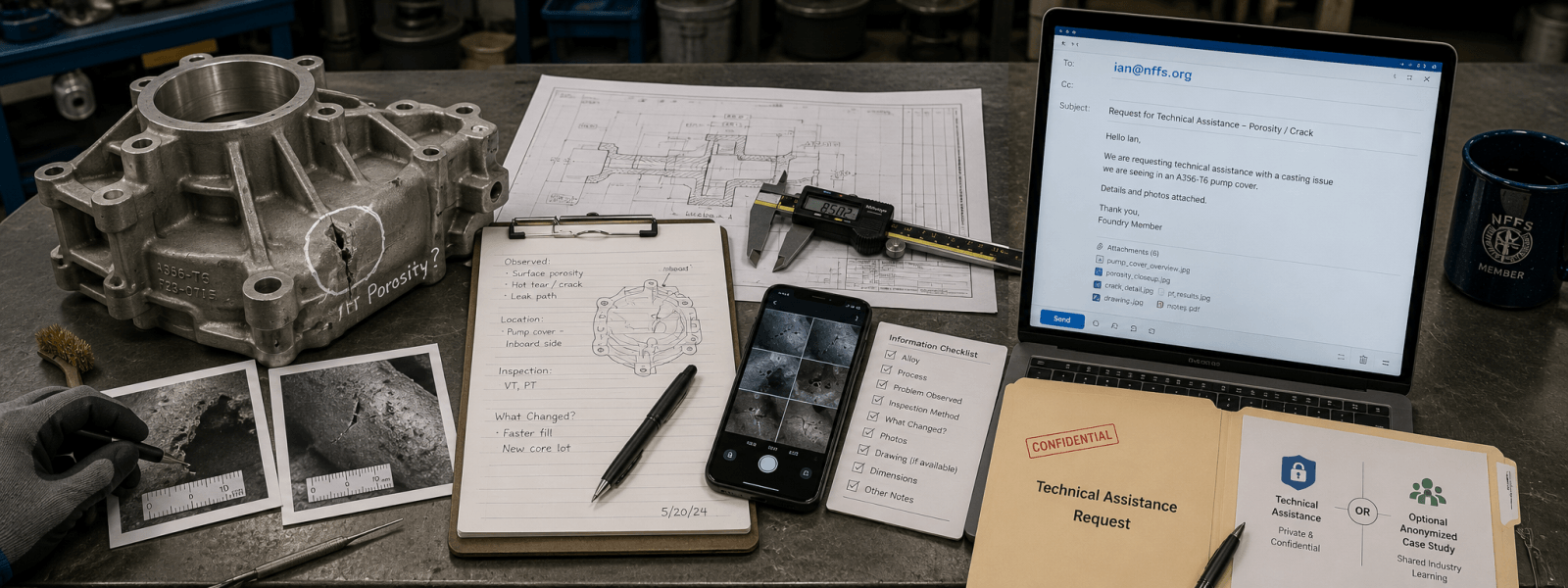
When possible, please include the following information:
- What alloy or alloy family is involved
- What casting process is being used
- What type of casting or component is affected
- What problem you are seeing
- When and where the problem appears
- Whether the issue is occasional, recurring, or worsening
- What inspection or testing method revealed the issue
- Any relevant photos, drawings, inspection results, chemistry data, or test results
- Any recent changes in material, tooling, process, staffing, suppliers, customer requirements, or production volume
- What has already been tried
Pictures are especially helpful. A photo of the casting, defect, fracture surface, machining issue, mold condition, riser, gating layout, inspection indication, or process setup can often provide context that is difficult to capture in words.
Once NFFS receives the problem, the first step is to understand it clearly. In some cases, NFFS may be able to help organize the issue, suggest possible causes, identify useful next questions, or connect the member with appropriate technical resources. In other cases, the problem may point toward a deeper investigation, outside expertise, laboratory testing, simulation, inspection support, or a future training topic.
Members have two options when they submit a problem.
The first option is simply to ask for assistance. NFFS will treat the information confidentially and work with the member to determine what kind of support may be useful.
The second option is to ask for assistance and allow the problem, once better understood, to be developed into an anonymized case study for the broader industry. In that case, all company names, customer names, employee names, proprietary details, and sensitive information would be removed before anything is published.
This second option is especially valuable. Many foundries are wrestling with similar problems, but the lessons often stay isolated inside individual facilities. By allowing NFFS to anonymize and share what was learned, members can help strengthen the entire non-ferrous foundry community without exposing their company or their customers.
A problem does not need to be dramatic to be useful. A recurring porosity issue, a confusing specification, a difficult repair question, a process change that improved results, or a defect investigation that finally found the real cause may all become valuable learning for others.
If something is costing time, scrap, rework, confusion, or customer confidence, it is probably worth a conversation.
To submit a technical problem, contact ian@nffs.org.
Your challenge may be the starting point for better support, better shared learning, and a stronger non-ferrous foundry industry.