
What We Are Hearing from Members: The Early Shape of the NFFS Technical Services Office
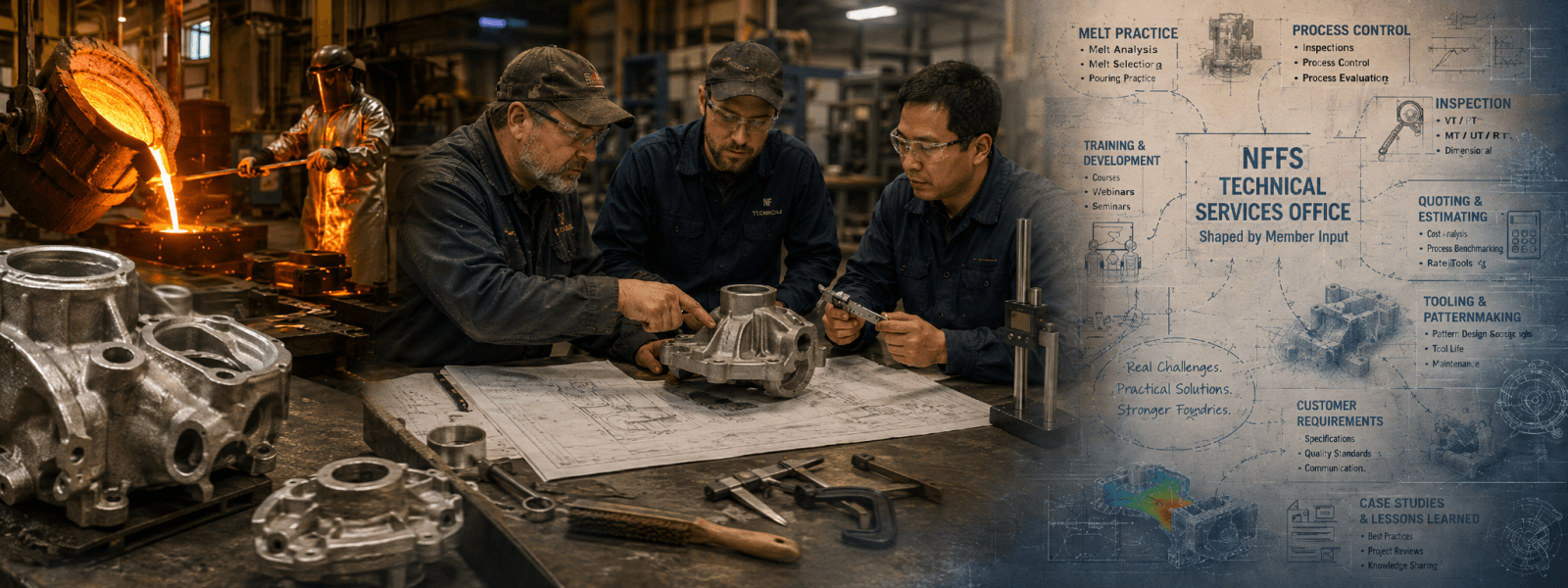
When NFFS announced the creation of the Technical Services Office, we made it clear that the office would be shaped by direct input from the membership. That process has already begun.
Over the past several weeks, NFFS has been speaking with foundry owners, technical leaders, operators, suppliers, and industry partners about the practical challenges facing non-ferrous foundries today. Those conversations are still early, and the Technical Services Office itself remains in its infancy. But several themes are already becoming clear.
The first theme is simple: members want practical technical support that understands real foundry conditions.
Foundries are not asking for abstract theory disconnected from the shop floor. They are asking for help with the kinds of problems that show up in production, quoting, customer communication, inspection, process control, and training. They need support that recognizes the realities of small and mid-sized foundries: limited staff, limited time, limited access to specialized tools, and a need for answers that can actually be used.
Many members already have deep experience inside their own operations. But even experienced foundries can run into problems that are difficult to diagnose quickly. A casting defect may appear to be a melt issue, but also involve gating, sand, tooling, section thickness, pouring practice, inspection expectations, or customer requirements. A recurring quality issue may not have a single cause. It may be the result of several small variables moving together.
That point has come up repeatedly: foundry problems are rarely isolated to one department or one decision.
This is one reason the Technical Services Office is being built as a “front door” for technical problem solving. The goal is not to replace the knowledge inside member companies. The goal is to help members organize the problem, ask better first questions, identify likely causes, connect with appropriate resources, and move toward practical next steps.
Another theme is that technical issues often begin long before production.
A quality problem may show up at final inspection, but its origin may trace back to the initial inquiry, drawing review, quote assumptions, alloy selection, tooling decisions, sampling plan, gating design, customer specification, or acceptance criteria. In other words, the best time to prevent a reject is often before the casting is poured.
This has important implications for the Technical Services Office. If NFFS support is limited only to troubleshooting after a failure has occurred, we will miss many of the highest-value opportunities. The TSO should eventually help members think through technical risks earlier in the process: during quote review, design-for-castability discussions, tooling decisions, sampling, process planning, and customer communication.
A third theme is the need for better access to specialized technical capability.
Not every foundry can justify full-time metallurgical staff, advanced simulation software, in-house X-ray capability, extensive laboratory access, or a deep bench of process engineers. Yet many of the problems members face require exactly those kinds of tools or perspectives.
This has been especially clear in conversations about aluminum foundries, where issues such as gas porosity, shrinkage, oxide films, melt cleanliness, temperature control, dross, returns, ladle practice, sand consistency, and inspection interpretation can become recurring sources of frustration. It has also been clear in copper-base alloy discussions, where melt practice, oxidation, charge control, repair procedures, microstructure, and inspection requirements can strongly influence final performance.
The lesson is not that every member needs to build every capability internally. The lesson is that NFFS may be able to help create better pathways to shared resources, trusted experts, laboratories, technical partners, training materials, and peer learning.
Another important theme is that the TSO must serve the full non-ferrous foundry community.
The R3 program begins with a focus on Nickel Aluminum Bronze and Copper-Nickel castings, and those alloy systems are important. But member conversations have made it clear that the Technical Services Office cannot be limited to one alloy family or one market segment. Aluminum foundries, copper-base foundries, zinc, magnesium, specialty alloy producers, sand foundries, permanent mold operations, centrifugal casters, investment casters, and others all face technical issues that deserve attention.
The mature TSO should be broad enough to support the diversity of NFFS membership while still being specific enough to provide useful technical content.
That balance matters. A general article about “quality” may be interesting, but a practical discussion about how to distinguish gas porosity from shrinkage, or how customer specifications translate into shop-floor process controls, is more useful. The Technical Services Office should aim for that level of practical specificity.
Finally, members have reinforced the importance of preserving and sharing hard-earned knowledge.
The non-ferrous foundry industry contains an enormous amount of experience, but much of it lives inside individual facilities, individual departments, or individual people. As experienced employees retire or move on, that knowledge can be difficult to replace. At the same time, many foundries are solving problems that other foundries would benefit from understanding.
This is one reason NFFS is building a confidential, anonymized case-study library. Members can bring completed case studies, or they can bring active problems that NFFS Technical Staff can help organize and develop. The goal is not to expose proprietary information. The goal is to turn real foundry experience into practical learning for the broader industry.
So what does this mean for members?
It means the Technical Services Office is being built carefully, from the ground up, around real member needs. It means NFFS is listening before overbuilding. It means the office will likely grow through a combination of technical problem intake, practical publications, case studies, training, peer discussions, expert connections, and targeted programs like R3.
Most importantly, it means members should not wait until the TSO is “fully built” before engaging with it.
If your foundry is facing a recurring problem, NFFS wants to hear about it. If your team has solved a problem that could help others, NFFS wants to hear about that too. If there is a training topic, inspection challenge, alloy question, process-control issue, or customer communication problem that keeps coming up, that information helps shape the direction of the office.
The early message from members is clear: the industry does not need another abstract technical program. It needs a practical, confidential, member-driven resource that understands foundry reality and helps convert problems into shared learning.
That is the Technical Services Office NFFS is working to build.