
Why Shrinkage Shows Up Where It Does
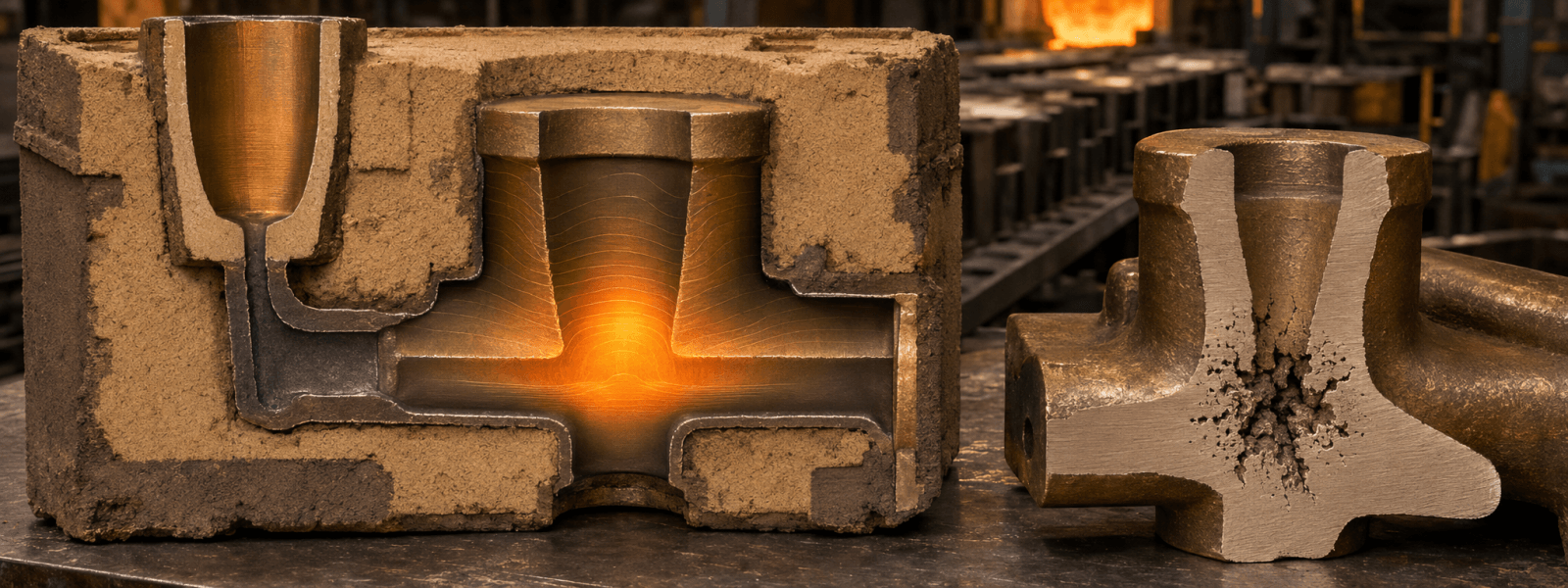
Shrinkage is rarely random. When a cavity appears beneath a boss, at the center of a flange, or inside a wall junction, it is recording the sequence in which the casting froze. Learning to read that location gets a foundry closer to the cause than arguing from pore shape alone.
Why the Last Metal Matters
Most non-ferrous casting alloys become denser as they solidify. The metal occupying a region needs replacement liquid while it freezes. If liquid can arrive from a feeder, the casting remains sound. If that route closes, the missing volume remains as a sink, cavity, or network of pores.
Shrinkage consequently favors thermal centers: portions that stay hot after their surroundings begin to freeze. Heavy sections are candidates, but geometry can create hot spots easy to overlook. Hubs, bosses, flanges, thick-to-thin transitions, and T-, L-, or cross-junctions concentrate metal. Oversized fillets and areas insulated by cores can do the same. The decisive quantity is not thickness alone, but how much metal must shed heat through the available mold-contact surface.
A Hot Spot Still Needs to Be Cut Off
Being last to freeze creates demand for feed metal; it does not automatically create a defect. Shrinkage forms when the hot region becomes isolated. A thin web, ingate, or feeder neck may freeze while the heavy section still needs liquid. A riser can contain liquid yet fail because it is too distant, lacks volume, or feeds through a resistant dendritic network. Simply enlarging the riser may not solve the problem. Location, connection, and timing matter as much as size.
Alloy Behavior Changes the Evidence
The same thermal problem can leave different evidence. Narrow-freezing alloys tend to develop a more defined solidification front, so unfed contraction often collects into a concentrated pipe or macrocavity at the final hot spot. Alloys with broader freezing ranges spend longer as a mixture of dendrites and liquid. As that network tightens, liquid must move through smaller, more tortuous passages. The result may be scattered microshrinkage or sponge-like porosity across the last-fed region rather than one cavity.
This is important in aluminum casting, where hydrogen can enlarge pores as pressure falls during interdendritic feeding. A defect can carry both gas and shrinkage contributions. Copper-base alloys have different freezing behavior and feeding demands. The physics is shared, but risering rules and defect appearance should not be transferred blindly between alloys or molding processes.
Read the Defect as a Thermal Map
An investigation begins by marking every indication on the part drawing, not just photographing the worst pore. Compare the locations with section thickness, junctions, core geometry, gates, risers, and chills. Then ask: Where was the final liquid? What was supposed to feed it? What froze between that region and the feeder? Did pouring temperature, pour time, mold condition, or feeder performance shift the thermal pattern?
Repeatability matters. A defect returning to the same location suggests a persistent hot spot or interrupted feed path. More random distribution deserves a broader review of gas, oxide films, inclusions, and filling behavior.
The corrective action is to make solidification progress toward a live source of metal. That may mean moving or resizing a feeder, opening its connection, feeding isolated zones separately, adding a chill, tapering a section, reducing concentrated mass, or changing gating so the feed path stays open. Simulation can reveal last-to-freeze regions before metal is poured, but radiography, sectioning, and records must confirm the prediction.
Shrinkage shows up where the casting runs out of liquid access before it runs out of solidification. Its location is not just the defect. It is evidence of the process that created it.