
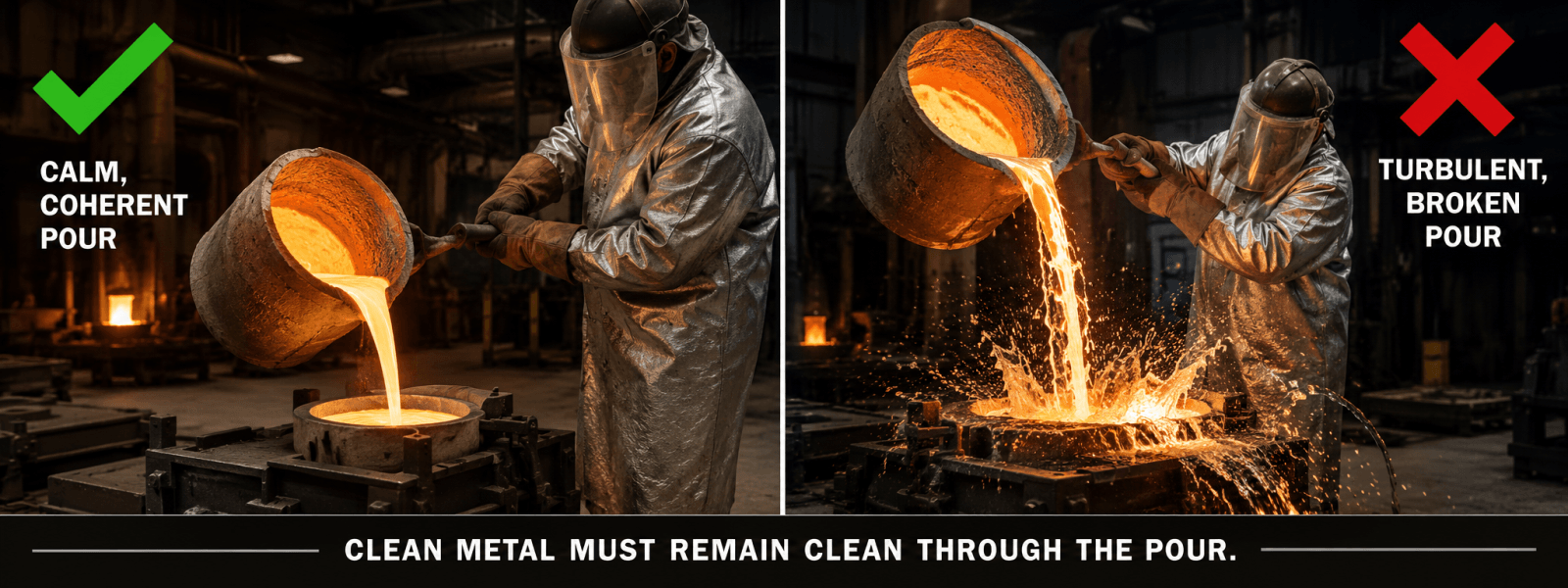
Why Clean Metal Still Needs Calm Handling
A clean melt can still produce a dirty casting. Chemistry may be on target, hydrogen or reduced-pressure testing may look good, and the dross may be skimmed. Yet castings still reach inspection with oxide inclusions, leaks, porosity, low elongation, or inconsistent properties. The reason is simple: melt cleanliness is not permanent. It must be protected from the furnace to the ladle, through treatment and transfer, down the running system, and into the mold cavity.
Most non-ferrous melts react with the atmosphere and develop a surface film. That film is not automatically a defect while it remains on the surface. Trouble begins when handling breaks, folds, or pulls it into the liquid. Two oxidized surfaces can double over with gas trapped between them, creating a double oxide film, or bifilm. In the solid casting, that folded film can behave like an internal crack, help pores open, contribute to leaks, and make properties less repeatable. Not every pore or reject is a bifilm—gas, shrinkage, inclusions, mold reactions, and solidification all remain important—but surface entrainment is one way good metal is damaged after it has passed its checks.
That is why clean metal still needs calm handling. A furnace treatment can reduce hydrogen and float inclusions, but the next violent transfer can create new defects in seconds. Recent work on aluminum degassing makes the point clearly: treatment is one part of an interconnected process, and strong surface disturbance can remove old inclusions while generating or re-entraining new oxide films. Cleanliness is a chain. The last uncontrolled step can cancel good work upstream.
What calm really means
Calm does not always mean slow, and it does not mean every flow must be technically laminar. The important issue is the free surface. A good stream stays coherent. The advancing metal front moves forward without repeatedly rolling over itself. The system avoids splashing, plunging jets, empty sprues, returning waves, vortexing, and stop-start pouring. Metal can move quickly enough to fill the casting while remaining controlled.
Pouring height matters because a longer fall accelerates the stream and gives it more opportunity to break up and carry air into the metal. Ladle position and lip geometry matter because a broad, separated, or fluttering stream exposes more fresh surface than a compact stream. Research comparing ladle designs showed that a more coherent aluminum stream reduced porosity and improved mechanical properties. Modeling work also found that reducing head height, controlling pouring time, and using a nozzle extension reduced air entrainment.
The mold’s running system then has to preserve that condition. A clean stream can still be damaged by a partially filled sprue, a hard impact at the sprue base, a sudden expansion, or a jet that hits a wall or core. Returning waves in runner bars and plunging jets at pouring basins are established entrainment mechanisms. The goal is not simply to get the mold full. It is to fill it once, continuously, without making the metal fight itself.
Filters help, but not as permission to pour badly. A correctly selected and placed filter can capture inclusions, reduce stream energy, and stabilize flow. It cannot reliably undo oxide films created by a long free fall, a surging basin, or a broken pour. Degassing is not a license to stir indefinitely, either. Treatment settings should provide useful bubble dispersion and inclusion flotation without opening a deep vortex, shredding the surface, or dragging dross back into the bath. Once treatment is complete, allow the required settling time, skim deliberately, and avoid remixing the surface into clean metal.
The principle crosses alloy families
Aluminum makes the lesson easy to see because it forms a strong oxide film rapidly, and much published bifilm work comes from aluminum casting. The principle is not limited to aluminum. Researchers have documented entrained double-film defects in magnesium alloys. Work on nickel-aluminum bronze and large C95800 copper-alloy castings also connects excessive filling velocity and turbulence with gas and oxide entrapment and reduced performance. The oxide chemistry and treatment practice change by alloy, but the operating principle remains: protect the surface, limit entrainment, and deliver the metal with controlled energy.
For aluminum gravity casting, a melt-front velocity near 0.5 meters per second is often cited as a useful warning point for surface-film entrainment. It should not become a universal number pasted onto every job. Alloy properties, section thickness, gating geometry, filling method, temperature window, and mold design all matter. The better shop-floor question is: where does the stream accelerate, separate, fall, reverse, splash, or trap air? That leads to observable process changes rather than false precision.
Protecting the melt in practice
Start at the furnace and follow the metal’s complete path. Watch the transfer, not just the treatment report. Keep ladles, lips, launders, tools, and pouring basins in controlled condition. Minimize unnecessary transfers and free-fall distance. Position the ladle so the stream enters the basin cleanly. Establish a steady stream promptly, keep it continuous, and avoid starving or flooding the basin. Match the pour rate to a running system that primes and stays full. Use bottom filling, tilt pouring, low-pressure filling, filters, stopper systems, or simulation where they solve the specific flow problem, not because one method is automatically best.
Simple observation can reveal a great deal. Under site safety rules, record several normal pours with an approved fixed camera or use another safe method. Look for stream separation, splash, slosh, pauses, basin-level swings, fountaining, or metal washing across the cope. Compare those observations with X-ray, leak, inclusion, mechanical-property, and scrap data. A foundry may discover that “operator technique” is really a ladle-lip, reach, basin, equipment, or staffing problem. The process should make the calm pour repeatable, not depend on one gifted person.
A good melt is essential, but it is only the starting point. Chemistry, gas control, fluxing, degassing, skimming, and filtration create value only when the handling system preserves it. Clean metal does not stay clean because the test passed. It stays clean because every person and every piece of equipment between the furnace and the casting treats the metal surface as part of the product.