
When the Mold Is Part of the Problem
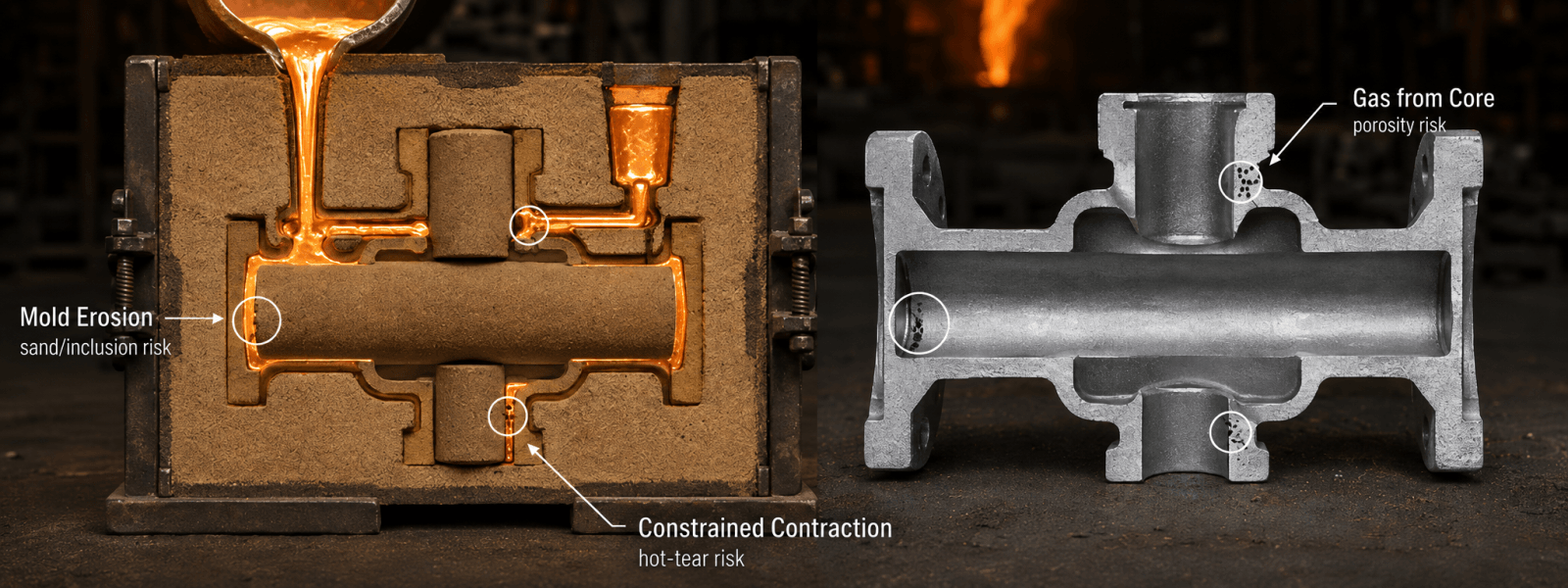
When porosity, an inclusion, a rough surface, or a crack shows up in a casting, the investigation often goes immediately to the metal.
Was the melt dirty? Was it too hot? Was there too much dissolved gas? Was the pouring stream turbulent? Was the chemistry wrong?
Those are all reasonable questions. But there is another possibility worth considering: the metal may have been in reasonably good condition when it reached the mold, and the mold itself helped create the defect.
A sand mold has more jobs than simply holding the shape of the casting. It has to maintain dimensional accuracy, withstand the forces created during filling, resist erosion and metal penetration, allow displaced air and reaction gases to escape, transfer heat appropriately, and eventually give enough to accommodate the contraction of the casting.
Cores have to do much of the same work, often under even more difficult conditions because they may be surrounded almost completely by molten metal.
The challenge is that some of these requirements work against one another.
A mold that is stronger is not automatically a better mold. A finer sand may improve surface finish but make gas movement more difficult. Additional binder may improve handling strength but also create more decomposition products when the metal arrives. A heavier refractory coating may protect the mold surface but can create problems of its own if it restricts permeability or is not completely dry.
Good molding practice is therefore a balancing problem.
Gas Can Come From the Mold
One of the most important examples is gas-related porosity.
When molten metal contacts a sand mold or core, the temperature at the mold-metal interface rises extremely quickly. Moisture becomes vapor. Organic binders begin to decompose. Coatings and other mold materials may also release gases as they heat.
That gas has to go somewhere.
In a well-controlled system, it moves through the porous sand structure and exits through vents, core prints, the parting line, or other intentional paths. If gas is generated faster than it can escape, pressure can build inside the mold or core.
At that point, the easiest path may be through the liquid metal.
This is especially important with complex cores. A core with a large surface area exposed to metal, a long path to the core print, limited permeability, or restricted venting can generate substantial gas at exactly the time the casting is filling and beginning to solidify.
A vent can also exist on the drawing and still fail in production. Coating can cover it. Adhesive can restrict it. Loose sand can block it. Core assembly can close off what appeared to be a perfectly reasonable escape path during design.
For aluminum foundries, moisture deserves particular attention because mold and core moisture can contribute not only to steam generation but also to hydrogen-related problems at the metal interface. A melt that was properly degassed before pouring does not make a damp core harmless.
This is why every gas defect should not automatically become a furnace investigation.
Mold Strength Has a Sweet Spot
The mold also has to survive filling.
If the sand surface is weak, friable, damaged, or poorly bonded, the incoming metal stream can erode it. Pieces of sand or coating can break loose and travel with the metal before becoming trapped elsewhere in the casting.
The visible defect may then appear well away from the place where the mold actually failed.
Core damage during handling and assembly can create the same problem. A cracked edge, broken corner, poorly repaired area, or loose sand left inside the cavity can become tomorrow's inclusion.
But making the mold as hard and strong as possible is not the answer either.
The casting contracts as it solidifies and cools. The mold and core need enough collapsibility to accommodate some of that movement. If the casting geometry locks around a particularly rigid section of mold or core, the mold can restrain contraction and create tensile stress while the metal is still weak.
In susceptible alloys and geometries, that can contribute to hot tearing or cracking.
Recent work with aluminum alloys has reinforced this point: reducing local mold restraint can reduce cracking in geometries where the casting is otherwise locked around the sand.
The practical lesson is important. The target is adequate mold strength, not maximum mold strength.
The Mold Also Controls Heat
The mold is also a heat-transfer system.
Sand type, density, core geometry, coatings, chills, mold temperature, and the local sand-to-metal ratio all influence how quickly heat leaves the casting.
That means mold variation can influence more than surface quality. It can change local solidification behavior.
A change that causes one area to cool differently can move a thermal hot spot, alter the available feeding path, increase the risk of a misrun in a thin section, or change where shrinkage eventually forms.
This becomes particularly important when troubleshooting a casting that has run successfully for a long time and suddenly begins producing defects. If the alloy, gating, and pouring practice appear unchanged, the next question should be whether the mold is really unchanged.
Has the reclaimed sand system drifted? Have fines increased? Has binder demand changed? Is the mixer still calibrated? Has the coating changed? Are cores being stored longer? Has humidity increased? Has the drying cycle changed? Are molds waiting longer before pouring?
A process can look identical on the traveler while behaving very differently in the flask.
Look for Mold-Side Evidence
When the mold is suspected, the best investigation is usually comparative.
Take a known good casting and a known bad casting and work backward through their molding history. Map the defect against the core geometry, ingates, vents, parting line, cope and drag orientation, heavy sections, and areas of high metal impingement.
Then look at the actual mold-making variables.
Binder addition, mixer calibration, sand grain distribution, fines, reclaimed-sand condition, mold or core strength, permeability, coating condition, drying, core weight or density, storage time, ambient humidity, vent condition, and time between molding and pouring may all be worth reviewing depending on the process.
For green-sand operations, moisture and compactability become particularly important. For chemically bonded systems, binder level, cure, sand reclamation, gas generation, permeability, and core venting deserve close attention. For coated molds and cores, application consistency and complete drying should be treated as process variables rather than assumptions.
The same principle extends beyond conventional sand casting. Investment molds, permanent molds, and other casting processes have their own mold-related variables involving temperature, venting, coatings, surface condition, thermal transfer, and dimensional stability.
The details change. The basic lesson does not.
A casting is the result of an interaction between the metal and everything it encounters.
A clean melt cannot compensate for a wet core. Good degassing cannot open a blocked vent. Excellent chemistry cannot prevent loose sand from entering the cavity. More binder cannot solve every mold-strength problem, and a perfectly sound mold cannot rescue fundamentally poor metal handling.
When a recurring defect refuses to respond to changes in the melt, it may be time to widen the investigation.
Sometimes the problem is in the metal.
Sometimes it is in the way the metal is handled.
And sometimes, the mold is part of the problem.