
What Manufacturers Should Be Watching: Insights From CMA 2026
What We're Hearing: Four Issues Manufacturers Should Be Watching
From AI and tariffs to energy and the 2026 midterms, the conversations happening across American manufacturing point to four issues foundries should be paying attention to now.
One of the most valuable reasons NFFS participates in national manufacturing forums is simple: it gives us an early look at the issues shaping decisions across the broader industrial economy.
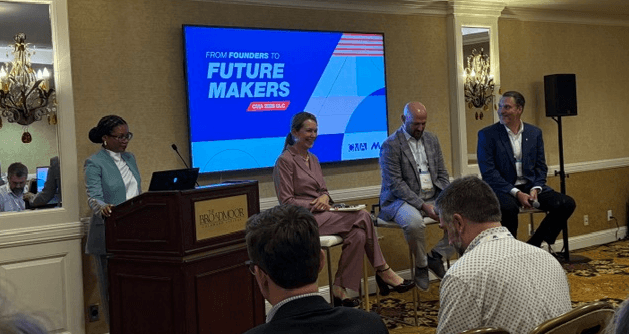
At the 2026 Council of Manufacturing Associations Summer Leadership Conference & Forum with State Manufacturing Leaders, executives representing manufacturing organizations from across the country compared what they are seeing, hearing, and preparing for.
One message came through clearly: policy, technology, energy, workforce, and global competitiveness are becoming increasingly interconnected.
The Issues Manufacturers Should Be Watching
These are not abstract national trends. Each has the potential to influence operating costs, customer demand, workforce decisions, capital investment, and the competitiveness of domestic foundries.
AI Is Moving From Conversation to Implementation
Manufacturing leaders are increasingly looking beyond the hype surrounding artificial intelligence and asking a more useful question: Where can this technology actually solve a business problem?
The conversation is shifting toward practical applications that improve productivity, speed decision-making, reduce administrative burdens, and help manufacturers do more with already stretched teams.
For foundries, this means beginning to identify areas where technology can create meaningful capacity, including estimating, quality documentation, maintenance, workforce management, customer service, and business development.
Watch for technology that gives skilled employees better information and more time for work that requires their experience and judgment.
Trade and Tariffs Remain a Moving Target
Trade policy continues to have significant implications for domestic manufacturing competitiveness, material costs, supply chains, and customer investment decisions.
Foundries should understand where their supply chains are exposed, communicate with customers about changing cost structures, and monitor how policy changes could affect imported inputs and competing finished products.
At the same time, the renewed focus on domestic manufacturing creates opportunity as customers place greater value on resilience, lead times, national security, and dependable U.S. manufacturing capacity.
Domestic foundries should be ready to clearly communicate the value and capabilities of producing cast components in the United States.
Energy Is Becoming a Competitiveness Issue
The growth of data centers, AI infrastructure, electrification, and advanced manufacturing is putting new attention on energy availability, affordability, generation, transmission, and permitting.
That matters enormously to an energy-intensive industry like metalcasting.
Reliable and competitively priced energy affects the cost of melting metal, operating equipment, making capital investments, and deciding whether future manufacturing capacity is built here or somewhere else.
As electricity demand grows, industrial energy users must remain part of the national energy conversation.
The 2026 Midterms Could Shift the Policy Environment
With congressional control at stake, manufacturing leaders are already evaluating how the 2026 midterm elections could affect the direction and pace of federal policy.
Regardless of party outcomes, manufacturers should expect continued debate around trade, taxes, energy, regulation, workforce development, permitting, defense spending, and domestic industrial investment.
For NFFS, the priority is not partisan. It is making sure policymakers understand a reality that can too easily get lost in Washington.
You cannot strengthen American manufacturing without strengthening the small and mid-sized manufacturers that make up its supply chain, including foundries.
Stay Informed. Stay Ready.
The themes emerging across the manufacturing community are increasingly connected. AI adoption can affect productivity and workforce strategy. Energy constraints can influence capital investment. Trade policy can reshape supply chains and customer decisions. Elections can change the regulatory and tax environment in which all of those decisions are made.
For foundries, the practical takeaway is not to react to every headline. It is to understand which changes could materially affect the business and prepare early enough to respond.
NFFS will continue participating in national manufacturing conversations so the foundry industry's perspective is represented and so members have better visibility into the issues that may shape the road ahead.
Foundries Don't Need More Noise. They Need Better Intelligence.
The value of being in the room is not simply hearing what everyone else is talking about. It is understanding which conversations matter to foundries and bringing that information back in a way members can use.
That is the role NFFS intends to keep playing: listening broadly, representing the industry clearly, and helping members prepare for what comes next.