
Stages of Procurement Readiness
Understanding the Stages of Procurement Readiness for Federal Government Contracting
Entering the federal government contracting arena represents a significant opportunity for businesses of all sizes. However, success requires strategic preparation and a clear understanding of where your company stands in the procurement readiness journey. The five stages of procurement readiness provide a road map for businesses seeking to navigate this complex landscape.
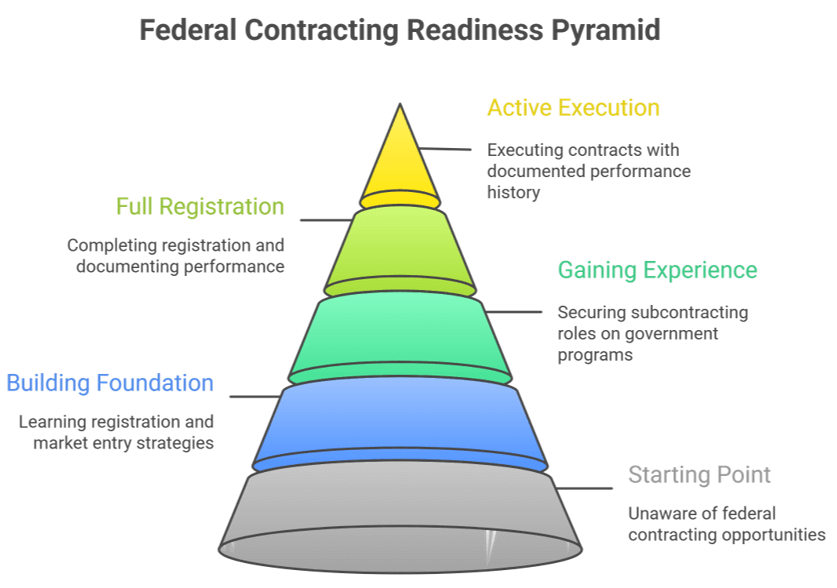 Stage 1: The Starting Point
Many successful government contractors began at Stage 1, having never considered federal contracting as a business opportunity. Companies at this stage may not realize that government agencies purchase nearly everything from office supplies to sophisticated technology solutions. The federal marketplace represents hundreds of billions of dollars in annual spending, yet many businesses remain unaware of these opportunities or assume government work is only for large corporations.
Stage 2: Building the Foundation
 Stage 2 marks the beginning of active interest. Businesses recognize the potential but lack essential knowledge about registration requirements, procurement processes, and market entry strategies. This stage involves critical learning about platforms like SAM.gov, understanding NAICS codes, and identifying which agencies purchase your products or services. Companies must also navigate the registration process, which can take several weeks to complete properly.
Stage 3: Gaining Experience
 By Stage 3, companies have typically secured subcontracting roles on government programs. This experience provides invaluable exposure to federal contracting requirements, including compliance standards, reporting obligations, and quality expectations. Subcontracting allows businesses to build relationships, understand agency needs, and demonstrate capability without shouldering the full responsibility of prime contractor status. Many companies use this stage to assess whether pursuing prime contracts aligns with their business goals.
Stage 4: Full Registration and Documentation
 Stage 4 represents a major milestone. Companies have completed comprehensive registration across key platforms including SAM.gov, obtained their CAGE Code, and registered in systems like DIBBS and PIEE as applicable. Critically, these businesses have documented past performance from private sector work, which can substitute for government experience when pursuing initial contracts. This documentation proves capability and reliability, essential factors in government procurement decisions.
Stage 5: Active Contract Execution
 The most advanced stage involves actively executing government contracts with documented performance history in CPARS (Contractor Performance Assessment Reporting System). CPARS ratings become a company's report card in the federal marketplace, directly influencing future contract awards. Positive performance ratings open doors to larger opportunities and establish credibility that takes years to build but can be damaged quickly through poor execution.
Moving Forward
Understanding these stages helps businesses set realistic expectations and develop appropriate strategies. Progression through the stages rarely happens overnight. It requires patience, strategic planning, and often professional guidance. Companies should assess their current stage honestly and create actionable plans to advance systematically rather than attempting to skip critical developmental steps.
If You Are in Stages 3, 4, or 5, You Might Find ICON Useful.
Learn more at www.iconportal.com.
Where are you in your procurement readiness journey? Take our 2-minute survey.